I always like to share how I connected with women to come on and share their stories for the Women Who Inspire Me series because sometimes it's in the most unexpected ways that you make a kismet connection.
This past year I decided that I wanted to be a podcast guest and speak on 10 different podcasts. I’ve almost met that goal, with just four more left for the year! (yes!)
What I’ve learnt is that sometimes we need to take one step at a time. To choose one show and then another, learning how to speak better along the way.
Throughout the year, I figured out what I love to talk about and how I love sharing the voices and talents of women, one website and story at a time.
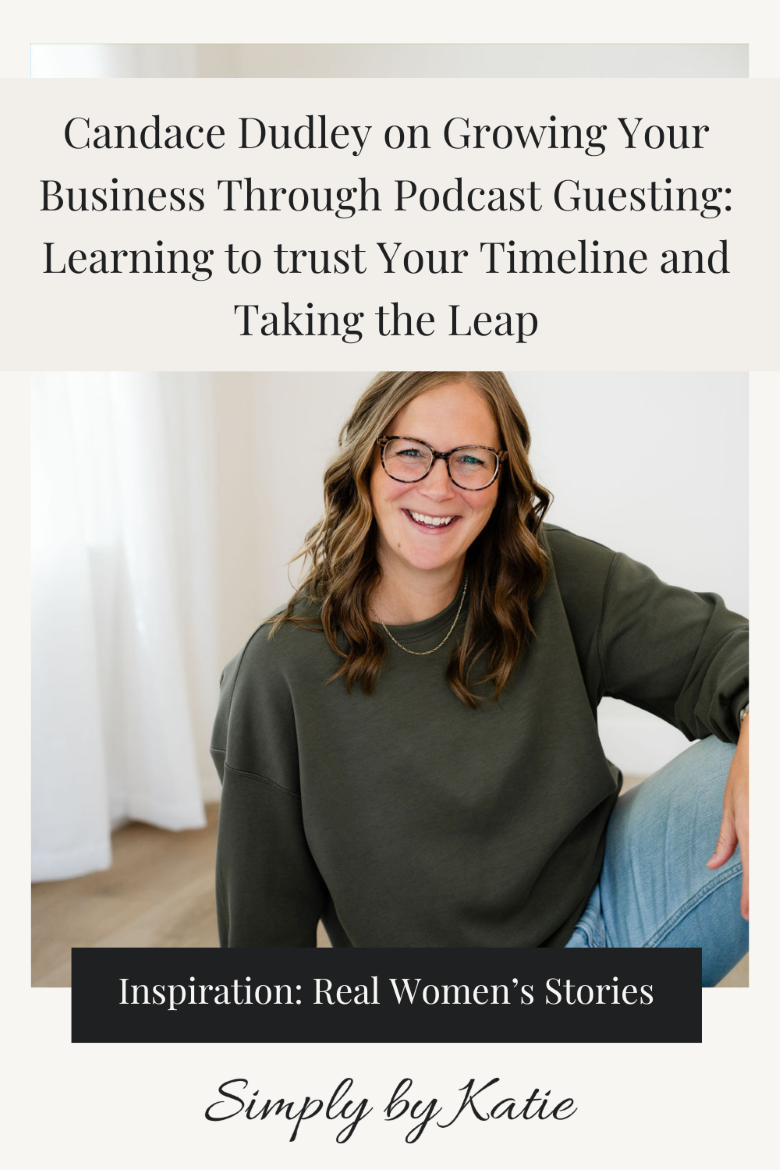
This is where I would like to introduce you to Candace Dudley, a podcast guesting strategist for coaches and service providers who want to grow their business through podcasting.
I initially found Candace on Threads, where I joined her podcasting matchmaking community. I am honoured that Candace shared her own journey of leaving her teaching career and how she fell in love with podcasting.
This is Candace’s story.
Women Who Inspire Me: Candace Dudley
Katie Eberman: Can you share a bit about your journey, the path that led you to where you are today, and the moment that really changed things for you?
Candace Dudley: I started with podcasting about 5 years ago when I launched my own show. But before that, I started listening to podcasts for the first time after I had my 3 kids. I had my kids back to back to back. They're 8, 10, and 11 now. So really close together. I always knew I wanted to be a mom, and at the time I was an elementary teacher.
I thought I would have done that for my whole life, but then you have kids and your priorities change. When I was home on postpartum, I wasn’t feeling like myself, and so that's where I started to look for personal development resources, which led me to podcasts.
I started listening to health and wellness podcasts to help better my mindset, and I've kind of fell in love with podcasts. I could do them while I was up in the night feeding the baby, and they fit where I was in life.
There was a time when I had all 3 kids in diapers, I was teaching full-time, and I was also running an accountability group for women through an MLM - my first entrepreneurial gateway drug.
I'll say that’s when I started to realize, “Oh, this is really cool. The harder I work, the better I get at this. I can make a bigger impact. I can make more money. There's no ceiling.”
Whereas teaching and the traditional 9-to-5 didn't allow for that.
So I started my own podcast for the ladies that I was coaching specifically. I wanted to create a space where they could feel heard and seen through my story because that's what podcasts did for me when I listened to them.
And I love the ripple effect that comes with sharing stories. Because when people hear a similar story to their own, they are given the chance to see what’s possible for themselves and make changes in their own lives.
At the beginning of the podcast, it was very much about motherhood, personal development, and mindset work.
Over the last 5+ years, it's transformed into using podcasts to grow your business, the entrepreneurial spirit, and female entrepreneurship. I still love a good mindset episode, but a lot of it has to do with the strategy behind podcasting, guest speaking on podcasts and collaborating like we are here.
It's my preferred way to network and market my business, but also it can be a strategic growth tool. It can be really powerful in your business, and so that's what I teach on now.
Trusting Your Own Timeline in a World of Overnight Successes
How to Use Podcast Guesting to Strategically Grow Your Business
The pivotal moment for me was not because I didn't like teaching, but because I didn't like who I felt like I was when I got home. I felt like my kids got my leftovers after a long day. My energy level would be at zero, and I didn't like that. It wore on me for probably 2 or 3 years before I finally decided I wasn’t going to continue doing this to both myself and them, because as we all know, time goes so fast when you have kids.
I first started with a leave of absence. I had a safety net that I could go back after the year was done.
But I never went back, and I don’t see myself returning to the classroom.
The transition to entrepreneurship was a little tricky to navigate. My husband is a teacher as well, and not the entrepreneurial-spirited type, which is a very different mindset to live in and be in.
There was a journey in communicating with him and learning how to share how important this was to me. A lot of times, he didn't understand, but he also was supportive of my decision. He could see that teaching was wearing on me, and so here we are five years later, making it work.
It's through all the twists and turns and pivots that I got to a point in my business of asking myself, “Where do I really want to focus my attention? What is it for me?”
Because there are a lot of things you learn to do on your own that create endless possibilities of how I could help people, but where do I really find my heart and soul?
And it was a lightbulb moment for me when I realized that the only thing that never went away this whole time was podcasts. Listening to them, creating my own every single week, no matter the season of life I was in.
That was a big, duh, Candace, it's been in front of your face this whole time.
This is where you thrive. This is what you love. It was obvious then, but it felt like a year's worth of wondering and exploring: what is it? Where am I going land?
It feels really good to be in this space now where I'm done with huge niche industry pivots.
And so now the pivots are smaller, more manageable for now.
Katie Eberman: I can relate to that, and I find that as women entrepreneurs, we have so many ideas of how we can help other women that it can feel like we are always starting over and not really making any progress. When you finally get to this space where you can make peace with the pivots being a part of your entrepreneurship journey and not a sign of failure, the journey starts feeling more rewarding.
What’s something you’ve learned along the way that you wish every woman knew, or a mindset, tool, or practice that’s helped you step into your full potential?
Candace Dudley: You have to go through some of those slower times of figuring it all out, and I wish it were faster for me. I'm sure everybody does. However long it takes to learn it or get through it is however long it takes. And so I think there's no right or wrong way for you.
Whatever is for you is for you.
Your timeline is your timeline, and that's what is great for you.
It can be easy to get stuck in the trap of seeing overnight successes on social media.
There are all kinds of challenges going on right now. Gap Challenge is the newest one. Someone made millions, and it seemed like it was overnight.
But we don't know the full story of all the months and years of work that she was doing before this new launch took off.
We don't get to see that in the world that we live in, and so it's important to know that things don't always happen that fast.
It doesn't make your own journey wrong or bad. You needed to learn something or get through that season for whatever reason, and that's how long it took, and that's ok.
Katie Eberman: I love that you bring that up because that is something, especially as an entrepreneur, that you're always looking at. You go on social media, and then you'll see someone post about how they made a million dollars overnight, causing you to spiral, wondering what you are doing wrong in your business.
So then you sign on to a new course or whatever it is. I love taking courses, but I'm at the point where I have a lot of knowledge now, and I just have to put it all together now and make a strategy that works for me. I do think it’s nice to have coaches that can walk you through your actual process and your actual life to create a realistic business for your life and goals, though.
Candace Dudley: Absolutely. You kind of get to this point of overconsumption. I love learning things too. Obviously, I'm big on personal development, but there does get to be a point where you use it as a crutch.
It's almost like you need to be aware of: am I using this to build myself up? Or am I using this to be like, wait, I can't do this other thing yet because I have to finish this book, I have to finish this course first, I need to learn this one more thing first before I can start this?
And in that case, we have to rip that band-aid off and give it a go because it's causing you to stop taking action. That's the point where you really need to trust how much you have learned and done.
Even if you've only had a few clients or you've only done the work for yourself, you have still done it. You've gotten yourself to this point, or a couple of clients to this point or lots of clients to this point. And that's a really big deal.
It's experience that other people don't have, and we forget that other people don't know what we know.
I just recently got my pictures done for the first time in years, and I was talking to the photographer about what I do. She was asking me questions about podcasting, mentioning how she likes to listen to podcasts, but she didn't have any idea that you use a computer for it, or that it's not just a mic or your phone.
That is an important reminder that we can get so used to what we’re doing that we think that it's easy for everyone, and it really is not.
You do have a lot of knowledge. You do have your own take and your own experience, and your people are looking for you.
Yes, other people teach podcasting. Other people do websites, but there are plenty of people in the world.
There are people for you and for me and for all of us.
Trust that there are people for you.
Because you can get caught in the trap of not taking action because you talk yourself into thinking, oh well, someone knows more than me, or is farther ahead than me.
I always honour that and say, yes, that's factual. That will always be true.
Someone will always know more than me, and somebody who doesn't. That is factual, and it doesn’t change my skills and talents.
Because there are people who want to know what you know, and there are people who want to know how you got to where you are today.
That makes you the expert because you did that.
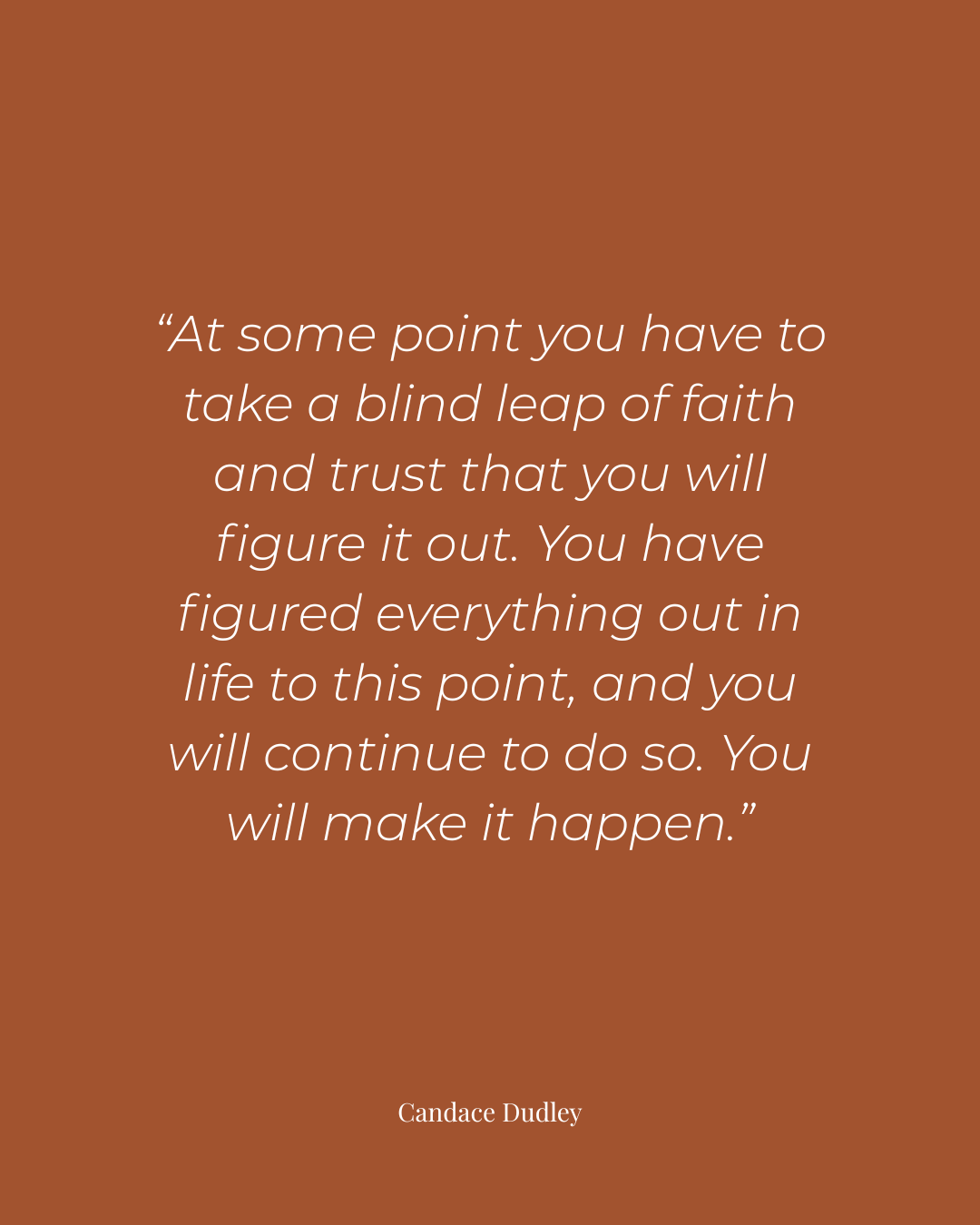
At some point you have to take a blind leap of faith and trust that you will figure it out. You have figured everything out in life to this point, and you will continue to do so. You will make it happen.
How to Use Podcast Guesting to Strategically Grow Your Business
Katie Eberman: I couldn’t agree more, thank you for sharing that. I’m wondering what is one thing you would tell a woman who is interested in guesting on podcasts to grow their business?
Candace Dudley: If you're feeling called to be in the podcasting space or, more specifically, to speak on podcasts, that's a chance for you to dip your toe in the water to see if you like the style and the format.
It's really a low entry because you don't need a lot of tech to get started or know how to edit.
You start by deciding what your speaking topics are going to be. That's often something people skip over, and they go straight to applying to podcast. But it's really key, especially when you're using it as a tool to grow your business.
Your speaking topics should be directly related back to what you do in your business and to your paid offers.
Think about what someone would need to know or be, or what mindset they would need to have or a level they've already reached, to then work with you.
The key is to keep repeating a very specific topic.
For example, in 2025, I spoke on 50 different occasions throughout the year about guesting on podcasts. What happens is you become the go-to in your niche.
From that, now I'm tagged almost daily when podcast guesting is brought up on threads.
I am invited to speak to virtual membership groups and summits.
When your niche is brought up, people think of you. You're the one they're referring people to. You're the one who is thought of, who is tagged, and who people want to buy from.
And when enough people are speaking your name, that speeds up the trust factor that we have to build, in order for people to buy from you.
Also, you can't AI your way through a whole episode. People want to know who you are, and what you stand for.
Because if someone is AIing their whole way through an episode, it's pretty easy to spot because they're reading the whole thing from their screen.
But when you do it right, and you are authentically showing up as yourself and have a go-to topic that you speak on, you are really setting yourself up for success.
Katie Eberman: For people who have tried to guest on podcasts and say that it was fun but didn’t end up with new followers, downloads or new clients, whatever it may be, what’s your advice for them?
Candace Dudley: A lot of times it's because you probably didn't come in with a speaking topic. Now you're leaving it up to chance, hoping that the host will ask you.
If you think about the big umbrella of my niche, it's podcasting.
There are a lot of things I can talk about. Same with yours, for example, websites. There's SEO or blogging. I mean, it's endless. So you can't just lead with your umbrella niche.
In the podcasting space, they could ask me about setting up a podcast, which I've done, so I can speak to it, and I can bring value to the episode.
But then, a disconnect happens because somebody who just listened to that episode and is so excited to start their own podcast jumps over to my social media, or they get on my email list. Now they're confused because I only talk about guesting over there.
Meaning that they are probably stopping right there. They're not taking any more action. They're not gonna follow you. They're not gonna buy from you.
While you could speak about a lot of things, go back to your offers. If you're not excited to speak about them, then that might be a sign that your offers are a little off, and maybe there's something you're more passionate about.
A question I like to bring up is: if you had to speak on a podcast tomorrow and you couldn't plan, what comes to mind? What could you speak on without being able to prepare?
A lot of times, there are topics in there.
If they don't fit what you do in your business, then maybe there's a disconnect between what you're doing and what you actually want to be doing. And it might be time to check on that before this journey.
Katie Eberman: I definitely can speak to that because I experienced that disconnect of not knowing what to speak about at first, and then as time progressed and the more shows I went on, I realized that I love talking about women’s stories and using their website as a way to grow their business.
Can you walk us through how you help women begin their podcast tour and start finding podcasts to be a guest on?
Candace Dudley: I'm a big believer that it matters what shows that you're on. You want to be aligned with the host. You want your message, your mission, and your values to match up in some way so that the audience is likely already searching for you.
Maybe they've already been Googling it for the last month, and you get on and talk about it and solve it for them in 20 minutes.
So that's the kind of alignment that I teach.
I work with both clients who are established and know that getting in front of aligned audiences is key to their growth.
And then with newer entrepreneurs who are really excited, they have a great offer. Maybe they're launching a book, and that's a great time to borrow established audiences.
A lot of times, a podcast host has been in it for years, and they have, even if they have a small following, a very loyal following who trust them, and that trust transfers directly to you.
Their audience knows they're not going to bring on somebody they haven't vetted. So that's really a great thing for someone newer to be able to tap into those audiences that are already established to help build your audience.
Katie Eberman: A common question people have is, do I need to have a following to start guesting on podcasts?
Candace Dudley: The answer is, I have never been asked about my follower count before guesting on a podcast. Instead, you can guest on podcasts to help build your following. And then you're going to see your following is going to be high-quality, aligned people that truly need what you're doing in your business.
Part of being on podcasts is building your authority in your niche. You become a speaker that people get to know, and you start to build connections with the hosts.
That's a big advantage because you get the opportunity to deep dive into conversation. Something that you would never do if we bumped into each other in a coffee shop or posted to social media.
Finding the Right Shows and Pitching with Confidence
Katie Eberman: Let's talk a little bit about kind of your tips for actually guesting on a podcast and figuring out how do you know that this podcast host and their audience is right for you to go and speak in front of?
Candace Dudley: This is the million-dollar question. Unfortunately, it's not as easy as typing it into the search bar and all of these perfect shows are going to come up.
No, what's going to come up are huge production company-type shows, for example, famous people, that kind of thing.
That's not who you're probably looking to guest on. At least, that's not who my people are looking to guest on, at least not yet. So we're looking for smaller, independently run shows.
The way you find them is that you have to find one first. So, for example, I have a show, and you could come over to my show, check it out, but then, likely, and this is true for me, a lot of my podcast guests have their own podcast.
You can now go on their show, and the same thing for them. Some of their guests will, in fact, be podcast hosts.
It's almost like following a breadcrumb trail when you're looking for those smaller shows, who may have an editor or a small team.
Where, if you talk to the host, they're the ones deciding who comes on the show.
If you get beyond that, then you have a production company where you don't know who to contact.
Any size show, I feel like, goes because, say, you speak on a podcast with a “small” audience- think about 30 people listening to you; if you were in person speaking to 30 people, that is huge.
Some people dismiss 30 downloads in a week really fast on a podcast, but if you were in a room and 30 people listened to you talk, you would be thrilled with that turnout.
Don't discount the small ones because sometimes those are the people that take the most action the fastest.
If you love a podcast that isn't run by a huge celebrity, check out their guests. Look at who they've had on, or see if that host has been on other shows. Head over to their website to see if they list other appearances, and listen to those.
To stay organized, use a tracker. I have a free one you can download here. Otherwise, it’s easy to feel like you’re not making progress. Take it step-by-step: browse recent episodes, read the show notes, and make sure your message is a good fit. You don’t have to listen to 100 episodes, but it is important that there is some connection there.
Also, make sure that they're taking guests. Some shows do not take guests, and they just do solo episodes. You'll be able to tell because you won't see any guests listed.
This is the part of my podcast tour offer that I do for people because, as I'm telling you this, it can feel like a lot. It’s not necessarily hard, but it’s time-consuming because there's legwork: you have to listen to the show, note it down, find the host’s contact, and put it all in your tracker.
On a different day, you send out pitches with your speaking topics. You lead with value and show that you've done your homework, telling them why you like their show and why you’re a great fit.
You’re looking for shows where you and the host complement each other. It can't be that you do the exact same thing, because they’ve likely covered your topics in solo episodes.
A lot of times I’m on female entrepreneur shows where the hosts run coaching businesses, memberships, and summits. But what they often haven't covered for marketing is podcast guesting. So I can come in and say, 'Here’s a different way to market your business,' and my talk complements what they aren't already covering.
That means their audience actually needs me and has a reason to take action and follow me, and vice versa. I then share the episode with my audience, who might need the host, creating an energetic exchange. When both audiences genuinely need the other person, that’s a beautiful thing.
Finding those shows takes time, and sometimes you have to test it out to see if it’s a fit. For example, I was on a show last year where the host shared alternative marketing strategies beyond just posting on social media, but she hadn’t covered podcasting. It was an easy fit, and people from that audience signed up with me directly from that episode because they were already looking for different marketing avenues. That’s when it makes perfect sense.
Katie Eberman: I love that, and I have had a similar experience in guesting on shows, and those collaborations are wonderful because they feel so genuine and authentic. It’s a wonderful way to grow your business.
I know that once a show is live, oftentimes I am sent the link to the episode and tagged on social media. Do you have any tips for sharing a podcast episode once it’s live?
Candace Dudley: Great ways to share it are with your email lists, carousels, and video clips. You can also make a playlist of all your guestings on Spotify, then you can use that when you apply to speak at something bigger.
Oftentimes the organizers are checking and looking for quality speakers. When you have a link with 10 curated shows you're on for example is huge. A lot of people aren't going to come with that, so it's really going to set you apart.
Giving Yourself Permission to Take the Next Step
Katie Eberman: When women read your story, what do you hope they walk away feeling or believing about themselves?
Candace Dudley: I hope women who read my story believe that anything is possible for them. Especially if it is something that's on their mind or heart and it keeps coming back up for you.
That's exactly what happened to me. That's how I ended up leaving a 13-year teaching career that I never thought I'd leave.
It's how I made every pivot in between.
Trusting yourself that you have figured everything out this far in your life, and you will continue to figure it out even though you haven't done some of the things you're going to do yet.
And it's on your heart for a reason. It wouldn't be there if it wasn't for you to do or to take action on, or take the necessary steps down that path to find out what it's leading you to. You might not be able to see the end, but it's important to take that next step that you can see.
That rings true in my whole life and journey. And so I just hope people feel empowered to take that next step that they can see, even if they don't know why, even if they don't know what the next step is going to be.
I know that I had one vision of my life thought out, and everybody around me was on board with that vision. And when you change it, it can be confusing to the people around you, and that can also make you feel more confused and doubt yourself.
It's just important to give yourself permission to move forward and not wait for other people to give you permission. Even if they love you and they want what's best for you, they can’t give you that permission, even if they wanted to. You're going somewhere that's never been on their vision board. So you have to permit yourself first and take that next step.
Here’s how you can connect with Candace:
Website | Instagram | Podcast | Threads| Podcast Guesting Tracker | Free Podcast Matchmaking Community