I think I say this every time, but I am so honoured each time a woman comes into my life to share their journey of motherhood and entrepreneurship.
I think one of the most powerful things we can do to create a legacy for ourselves is to share the parts of our lives that helped shape us.
Often, it’s not picture-perfect; it’s hard, it’s painful, or maybe it was a time period of questioning, ok, what’s next?
What I want more than anything is for women to feel seen, heard and validated in their experiences.
To know that they are on the right path, even when it seems like they are lost among a forest of ideas and what-ifs.
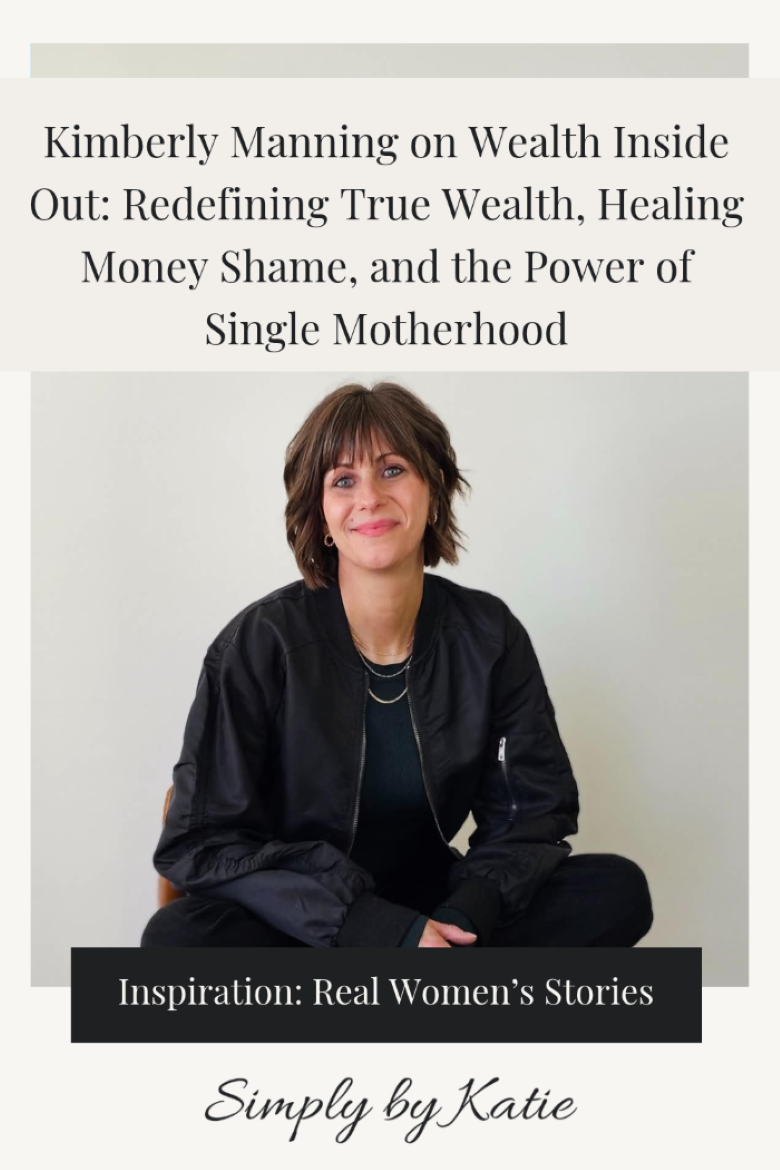
This is where I would like to introduce the amazing Kimberly from Wealth Inside Out.
Kimberly and I both attended Trailblazer Live in 2025, and connected after the event when she responded to a post I made about coming and sharing her story. I believe that the right people come into your life exactly when you need them to, and this is no exception to that.
We bonded over our experiences of single motherhood and how we both, for the first time opened up about our journey of entrepreneurship and single motherhood on public platforms has lead to a path of healing and acceptance.
Working in finance for the last 23 years, including nearly 20 years at a bank. Kimberly found herself pivoting into coaching and advising for women after feeling unfulfilled in her corporate role.
Her work now focuses on helping single moms, divorced women, and all women build healthier relationships with money through mindset, systems, and healing. She described her approach to financial well-being as an inside-out wealth concept with the belief that true wealth includes inner well-being, rest, and self-connection, not just money.
This is Kimberly’s story.
Women Who Inspire Me: Kimberly Manning
Katie Eberman: Can you share a bit about your journey, the path that led you to where you are today, and the moment that really changed things for you?
Kimberly Manning: I have been in Finance for 23 years now. Prior to entrepreneurship, I was employed with one of the Big Five banks. I went through all of the different positions that I could possibly go through, climbing the corporate ladder and being a typical corporate-type woman. The one who just wants to be successful and who continued to push herself.
I became a single mom 14 years ago, and having a solid income with benefits was extremely beneficial during that time.
But just before COVID, in early 2020, things really started to shift for me. I wasn't happy in the current role that I was in. Where I live, there was really no other role that I could take on.
My girls, their father and our family are here, so moving to Calgary for more opportunities wasn't really an option. I knew I didn't want to keep doing what I was doing. I felt like I was at this crossroads and this breaking point.
I had no idea what I was going to do, where it was going to take me, or how I was going to move forward with two kids.
I found myself praying to the powers that be, saying to them, I need help. I need guidance. I can't keep doing this.
What happened was I fell down my stairs, and I broke my ankle. It forced me to slow down, and I took that as a sign, as a nod telling me that I needed to stop. I was receiving the message of “you need to stop spinning in circles and give yourself time to heal and to really look inwards and figure it out.”
Two weeks later, COVID happened. So then we were on lockdown. I suddenly became a mom who was homeschooling, a mom who was trying to find her own path, who was also healing from a broken ankle, and a mom who needed to focus on her mental health while also navigating her career.
Everything was just kind of piled on top of me.
But I had seen a life coaching certification through The Angry Therapist, John Kim. At the time, it was called JRNI Life Coaching, and it was based on positive psychology, neuroplasticity and how we as humans operate. I found it fascinating work. So I took the certification, not really thinking that I was going to use it for more than for myself, my own self-development, and to learn different things.
From that, I started a divorce group for women. At the time, I had experience with separation, divorce, and being a single mom. It was a good experience, but I also felt like I wasn't quite ready for that.
So I went back to the drawing board. I knew that psychology and how our brains work was something that interested me, and I found a trauma-of-money certification.
It looked at our nervous system, our patterning, how we're wired and how trauma affects us and our bodies. It was something I could get behind because I've been in finance for so long.
I wanted to create something for women where they could feel seen in their money and in their stories.
Because so often in the banking industry and in the finance industry, I think it's getting better, but it has been more geared towards focusing on the men and their roles as being the provider.
Whenever there's an interview or studies, typically, you're talking to a man. And women, they do want to be involved in money. It's just that they don't know how.
I started focusing on single moms, single women, divorced women, women who are holding the weight of the world - being the provider, the nurturer and empowering them with their own money.
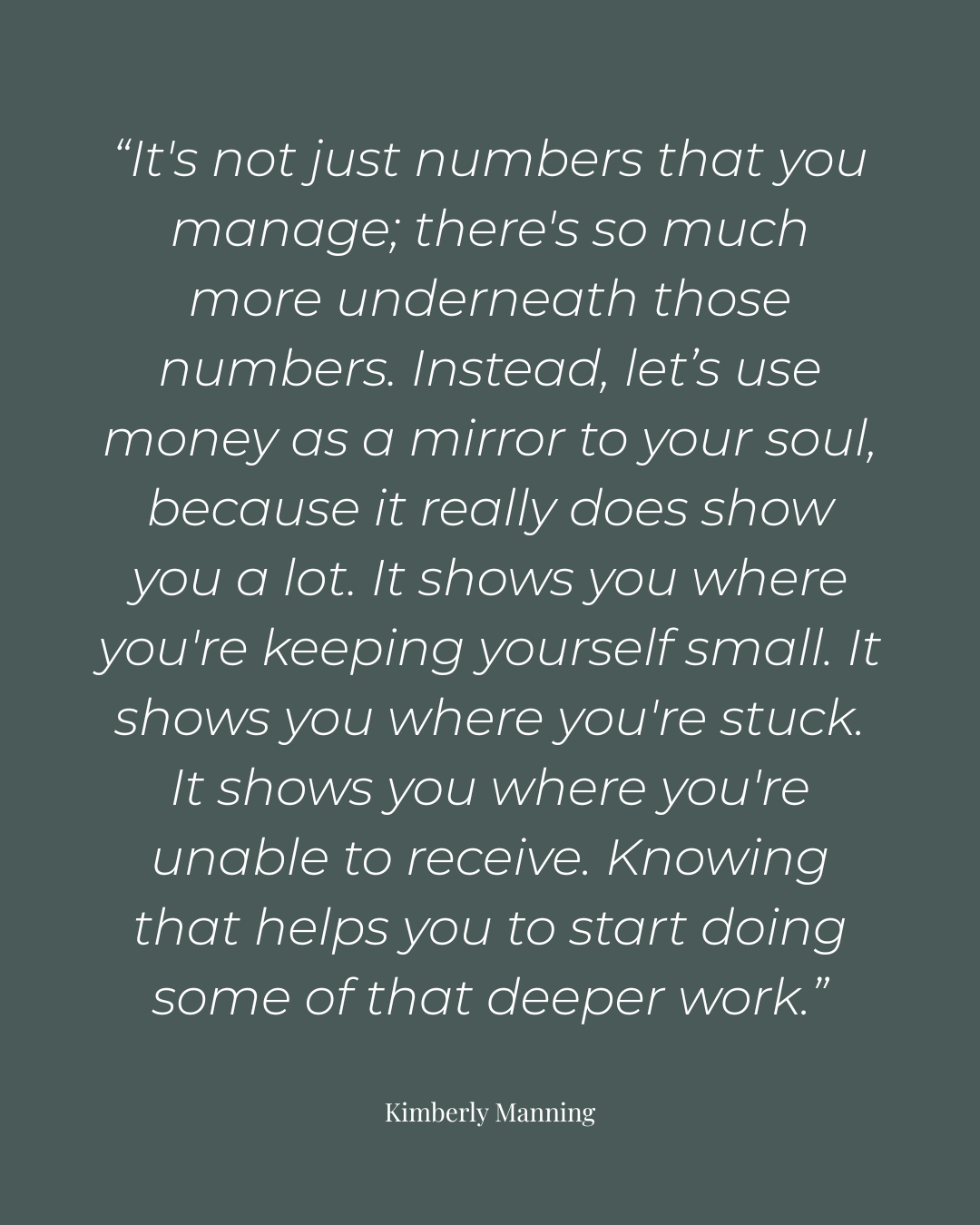
It's not just numbers that you manage; there's so much more underneath those numbers. Instead, let’s use money as a mirror to your soul, because it really does show you a lot. It shows you where you're keeping yourself small. It shows you where you're stuck. It shows you where you're unable to receive. Knowing that helps you to start doing some of that deeper work.
It's just been a fascinating journey.
I love teaching women to build structure around their money and create systems that work, because the numbers are important. The numbers need to make sense, and they need to work. But what I think is even more important is building a relationship with money that lets us to thrive, rather than constantly beating ourselves up.
We experience avoidance patterns, anxiety, or cycles of shame because there’s often a lot of shame surrounding our money. It’s something we need to work through.
I created a mentorship for women that brings together the practical and personal sides of money. We look at the numbers, but we also explore the behaviours, habits, beliefs, and patterns that influence how we manage money and make financial decisions. The goal is to help women build a stronger financial foundation and develop a more confident, empowered relationship with money.
Alongside that, I have a financial advising practice where I work primarily with women, helping them build and grow wealth through investing and financial planning.
Although the work looks different, both sides of my business are rooted in the same belief: wealth isn’t just about how much money you have. It’s also about how you manage it, how you feel about it, and what it makes possible in your life.
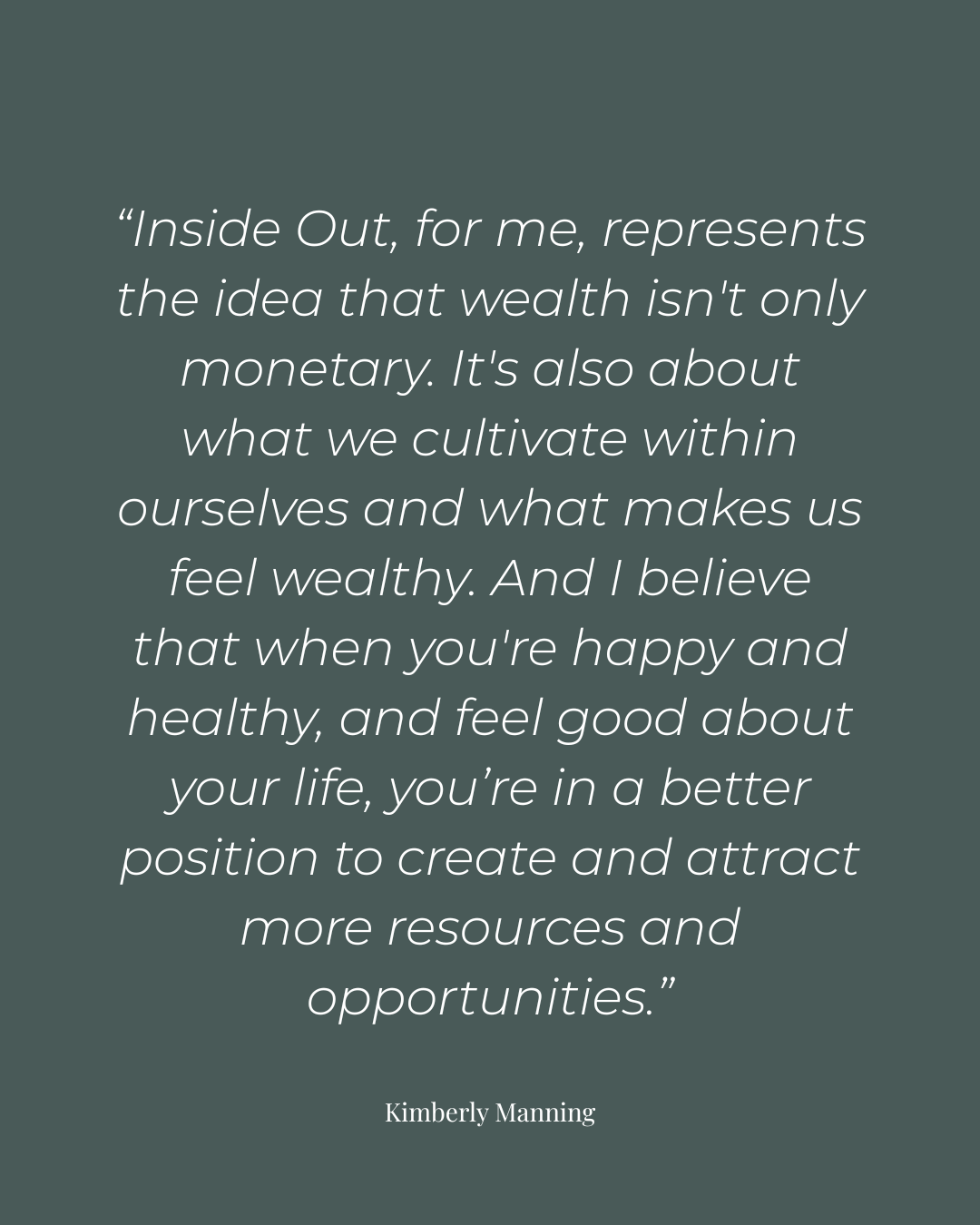
Inside Out, for me, represents the idea that wealth isn't only monetary. It's also about what we cultivate within ourselves and what makes us feel wealthy. That could be something as simple as sitting on the deck underneath the sun, reading a book, or connecting with yourself. That's what true wealth means to me. And I believe that when you're happy and healthy, and feel good about your life, you’re in a better position to create and attract more resources and opportunities.
That's the whole thought process behind it.
Moving Beyond Survival Mode: Nobody Gets It Like a Single Mom
Katie Eberman: I'm a single mom as well, so it's nice to connect with another single mom. I don't know if you are still a single mom, but it's nice to connect with another woman who has had that journey as well. My mom was a single mom, and I remember saying to myself that I'm never going to be a single mom.
Kimberly Manning: I hear you. My mom was also a single mom to two girls, and I had those exact words come out of my mouth. I will never be a single mom.
Nobody gets married planning to get divorced, but it's all part of the journey.
I do find that, through all of these evolutions, I'm coming more and more back to divorced women and single moms. It’s been six years since I ran my group for divorced women, and I've healed even more since then.
My capacity to hold them is so much greater.
The women in my group got a lot out of it, and they felt supported. I didn't feel supported in that.
Now I'm kind of moving through that journey of, I'm 43, midlife. My daughters are now 19, and my youngest is 16. They don't need me as much. And the identity that I built for myself was being a mom, being needed, on being that person - the fixer, the guider, the nurturer.
All of the things.
And now it's coming back to finding out what makes me happy and how am I going to create that for myself? Because putting myself first is not selfish.
Single moms have a really special place because nobody gets it like a single mom.
Katie Eberman: I was on a few podcasts this year, since Trailblazer Live, and before then, I actually never talked about being a single parent, or anything like that.
On one of the first podcasts that I recorded, it was the first time that I actually said it out loud and that I was willing to actually talk about it.
The host was actually at Trailblazer Live, and I didn't realize when I went on that she also was a single mom for a period of time. Maybe that's why I ended up opening up to her, because she could get it, and unknowingly, held that space for me to feel safe and seen.
Ever since that, I'm more comfortable with actually talking about it. And I feel like that's been a big step for me to be able to share my reality, because I had a lot of guilt and shame at the beginning, and it still does come up for me today.
I never knew what my mom actually went through until I had to go through it myself. And I experienced firsthand that, oh, this is really hard. Nobody really talks about it because I think we're just surviving. We're just getting through it. There’s no processing or healing happening until we have space to do so.
Kimberly Manning: Yes, and that's so key, we’re surviving.
That's what I've done for 14 years. And I still am. I'm still a single mom. I'm still a mom. I have way more responsibility now.
And that's where I'm at right now. I’m moving beyond surviving. I feel like I’m closing a chapter of my life, and what’s unfolding is something completely different. Something I’ve never really experienced before.
When survival has been your only way of life for 14 years, it's incredibly hard to shift out of that mindset. It’s what you’ve known for so long. Learning to live differently, rather than constantly operating in survival mode, is a whole other process.
I remember at the very beginning of my journey, I wouldn't tell people I was a single mom. I didn't want people to look at me differently. I didn't want people to pity me. I didn't want them to think that I needed extra help, extra support. I was very much in this frame of mind of, “Nope, I got this.”
And that's how I carried out over a decade of my life.
I didn't want to share it.
So good for you for sharing that. It's important.
Katie Eberman: I don't know why I did, but I did. But it's funny because I didn't just share it with one person. I shared it publicly.
And then one of the stories that went out earlier this year, we actually connected because she shared on a podcast how she kind of rebuilt her life after being divorced and being a single parent and then getting remarried and building a new way of life for herself.
There's a lot of healing in that.
Kimberly Manning: And I think your body knows. You know, not sharing it, I was protecting myself. When you're able to remove that mask and just be honest and open up about it, does it help the women that need to hear it.
Something similar happened to me when I was ready to share more of my journey.
I was part of Volume 3 of the Lighthouse Project, put on by the incredible Carrie Scollon.
In that book, I spoke about things that I've never spoken about before. It took 14 years to get to that point, and that's a long time. But as you said, I actually shared my story publicly for the first time in a published book.
And since then, I’ve started talking about it more because the shame I carried has started to come up and move out of my system. It became another layer of healing, another layer of unravelling, and it's been really beautiful in that way.
Katie Eberman: It’s an amazing project. Carrie just holds that space for women so well. Were you able to attend the book launch in Calgary?
Kimberly Manning: I was able to speak there, and my daughters came, which was incredible.
They loved it, and they cried as they heard my story. It’s an interesting experience having my daughters at an age now where they're learning things about my journey that they had no idea about.
That was part of the protection piece, right? You protect your kids by doing all of the right things. But I also realized that while I was protecting them, I wasn't allowing myself to be seen. I wasn't allowing myself to be supported because I felt like I had to be strong. I had to be the one who figured it out and just be okay. That part was really, really tough.
Katie Eberman: I appreciate you sharing that, because I know it’s not something that is easy to open up about. And that's why I really I’m so passionate about this series. Is because it gives us the opportunity to have these conversation. We’re not having these conversations on social media or in our daily lives, and it's important.
I feel that it’s my calling to write women’s stories to create healing and connection.
I want women to read your story and reach out to you because they see themselves in your journey, or maybe they need your help to create a new story with their money.
I want to share women's stories to then also help us all to grow each other's businesses and create an ecosystem that feels good for everybody where everyone can build wealth and, and build their businesses in a way that feels good.
Money as a Mirror: Healing Trauma, Patterns, and Financial Shame
Katie Eberman: What’s something you’ve learned along the way that you wish every woman knew, or a mindset, tool, or practice that’s helped you step into your full potential?
Kimberly Manning: What's helped me on my journey is becoming more self-aware and getting curious as to why I operate the way I do. It’s also recognizing that t I have power and agency to lead my life. If there’s a moment where I'm feeling stuck, there's usually a reason.
There's something I'm missing, or perhaps it’s a reminder that I need to slow down or look at things from a different perspective. I believe our lives unfold in ways that help shape us, and that the challenge we experience can grow us into the people we’re becoming and give us the skills to help others.
And if I'm really struggling or going through a dark time, I'm not saying that it's easy. It's far from easy. But there’s an inner knowing that I've been in the dark before, and I've found my way through it.
I've learned so many things about myself through those experiences, including the importance of finding anchors in your life that help guide you when things feel uncertain.
So, one thing I spoke about in the chapter, and something that’s been part of my life, is that there are certain things that help guide me. For example, one of my signs is a bumblebee.
When things aren't going well in my life, when I'm really struggling or feeling alone, I'll ask for help, ask for guidance, ask questions, and spend time journaling. And then bumblebees will start popping up everywhere.
I’ll see pictures of them, posters, or something similar, sometimes multiple times a day. For me, it brings me a sense of peace. It’s a reminder that I’m being seen and guided, that I’m exactly where I need to be, and that I just need to keep going.
That’s what I would share with anybody who is going through a rough time.
Over the years, my girls have always been my anchor. They've always been my why.
They've saved me time and time again when I didn't think I would make it through. They are a big part of the reason I kept going. My love for them gave me something to hold onto, and sometimes, that's what we need.
Katie Eberman: Yeah. It's true. Oh, I'm teary over here. I feel exactly the same way. Let’s take a drink of water here.
That's beautiful advice. And I like how you tied it back to seeing your sign, the bumblebees, when you're needing that extra reassurance and how they show up for you when you call on them.
I'm trying to think of what my sign is. I should just play around with it. I feel like I always see little white butterflies flying around, and then I know I am going to be ok.
I don't know if it's a single mom thing or a mom thing or maybe it's just my personality, but there will be times when I need some guidance, some reassurance that I am on the right path and I am doing the right things. I feel like it could be a single mom thing because we don't really have anyone to bounce ideas off of, and we are always having to be the one who is ok, and sometimes it's nice to be like, I just need a sign that I'm on the right path.
Kimberly Manning: Yes, yes, I agree. The words that keep coming to my head are emotional sufficiency. As single women, we can become so accustomed to processing things, making decisions, and managing our own emotions that we don’t always realize how much we’re doing on our own.
Instead of having someone to ask, “What do you think about this?” that's something I've missed. Having a co-parent or another parent beside me to navigate some of those decisions with.
For example, I don't know how to parent a 19-year-old at times. I’m trying to give her the freedom to live her own life, but she’s also living under my roof, and there are expectations that come with that.
It's really difficult.
And it's just us. Nobody gets it like a single mom.
Rewriting the Money Narrative: Why Women Carry Receiving Wounds
Kimberly Manning: I've noticed in my work that women are very hard on themselves. I recognize that because I am very hard on myself, too. Working with someone around their money is a very vulnerable way to meet somebody. Because of that, the way that I hold space for my client is with deep respect, reverence and vulnerability.
It's important to me that women feel safe enough to open up about things they may have never spoken about before.
As I said earlier, money carries so much shame. It can carry anger, resentment, and stories about our families and how we were raised. It takes emotional attunement to walk alongside my clients' process, while also challenging some of the beliefs they may be carrying that aren't necessarily true anymore.
It's not always until you have a coach who can mirror things back to you or ask really important questions that deeper healing and peace begin to happen.
You could do all the work on your own. You can journal, listen to podcasts, read books, and do all the things that help you grow. You can think you’re pretty self-aware and have done a lot of personal development, but there’s something different about being witnessed by another human being. That’s often where things really begin to shift.
I think this is where ChatGPT comes into it. You can vent as much as you like, and it can validate you, help you process your thoughts and come up with ideas. But it is completely different when you're sitting across from another woman who’s witnessing where you're at, and helping you through them.
It’s a really important part of my work to understand my clients' money stories and how they were raised, and where some of those patterns originated. There's a reason some women avoid money, and there's a reason others experience anxiety around it. Often, these are familiar coping mechanisms. They're looking for a sense of safety, and sometimes that safety isn’t found in numbers alone. It comes from doing the deeper work, too.
Again, the numbers are important. We all need money to survive. But there’s also so much happening underneath the numbers. My approach isn’t your typical financial advisory experience, where you imagine walking into an office, sitting across from someone behind a desk in a buttoned-up shirt, with a very business-oriented, Type A approach.
It's that, and a lot of heart, a lot of healing, a lot of education, and a lot of support.
Katie Eberman: Oh, I love that. It's beautiful. I feel like women really need that space. I've been reading a lot of financial books and recently heard a stat about women and money that was just crazy.
It was about women who have been married their entire lives and find themselves in the situation where their partner dies, and they are suddenly responsible for everything. The statistic is that 80% of them end up in poverty after this experience.
And I was just thinking that is scary. That's almost every woman. That can't be true, but it is. So I am grateful that you're doing this work, because you're going to empower so many women to feel comfortable with money and to rewrite their money stories and then to know how to always support themselves no matter what.
Kimberly Manning: And I think there are so many women who are single now, by choice as well, and they need to learn the skills to manage their money. Unfortunately, it's not something that we are taught in school.
I believe those stats will change, especially with the divorce rates and the way my kids' generation is thinking about relationships and family. My girls are both looking at me right now, saying they don't think they want children. They’re looking at the world and questioning whether that’s something they even want for themselves.
We’re having these really serious conversations. Why would I do that? I don't even know if I want to be with somebody. Why do I have to be with somebody?
Those generational beliefs are starting to shift as well. And I think money is going to be one of those things that gets completely revolutionized over the coming years. That’s my belief.
In my opinion, finance is a very calcified structure, built by men and largely designed for profit.
I think there are other ways we can approach money that feel better. Approaches that feel more forgiving, more supportive and more useful.
Because money is just as much about giving as it is about receiving.
And I think a lot of women, myself included, carry wounds around receiving. We believe we don't need help. We believe we can do it all on our own. And those wounds often translate into how we relate to and manage money.
If we believe we can do everything on our own, we can also struggle to receive. So how do we learn to receive money when it starts coming in, if our natural response is, “I’m good. I don’t need it”? It’s all very intricately intertwined.
Katie Eberman: I was having a conversation recently, and we were talking about how so many women don't even know how to hold the wealth we want to create for ourselves, because our nervous systems don’t feel safe to hold it.
And so until we really dive into that and heal that will be really be able to actually, receive all the money that we're wanting and do all the good that we want to do.
Because I feel like women are very giving, and we want to make sure everyone's happy and good. I believe that entrepreneurship is a really beautiful pathway to heal that.
Kimberly Manning: Yes, and I can't deny it. I think all of our wounds are staring at us, sometimes smacking us in the face every single day.
When we talk about the nervous system, it's about expanding our capacity. Our nervous system has familiar patterns and a certain threshold for what feels safe and comfortable. And until we learn to move beyond those familiar patterns, it can be difficult to receive or hold something different.
If money already makes you feel anxious, having more of it can sometimes bring up even more anxiety. And if you haven’t developed the capacity to manage that shift, you might find yourself falling back into familiar patterns or behaviours that undermine what you’re trying to build.
You can end up sabotaging the very thing you’re trying to create.
When money doesn't feel safe, you might find yourself giving it away, spending it, or prioritizing everyone else’s needs instead of your own.
So, let’s start creating a plan for that.
Giving Yourself Permission to Choose What Your Soul Actually Wants
Katie Eberman: When women read your story, what do you hope they walk away feeling or believing about themselves?
Kimberly Manning: I believe that the more wealth we have in the hands of women, and in the hands of good people, the more we can transform certain aspects of our world. I want women to know that they have a choice.
You don't have to rely on somebody else financially. You can learn how to support yourself in a way that honours you and the path you want to take.
When you're faced with a difficult situation, it can be an opportunity to discover what you're made of and what you’re capable of moving through.
At the same time, stay open to possibilities. Open yourself up to support and love, because the path you’re on today is part of where you need to be.
There's a path I took because I thought that's what I was supposed to do, and maybe you’ve found yourself on a similar journey.
I thought I was supposed to buy a house.
I thought I was supposed to have a career.
I thought I was supposed to have a husband.
I thought I was supposed to have kids.
I thought I was supposed to have the white picket fence.
I had all of that, and it still didn't work.
You have the choice to ask yourself, “What does my soul actually want now?” Deep down, you know what you want. Being able to stay true to that, even before the world tells you that you can't do it, is one of the biggest things you can do for yourself.
Who says I can’t be a single mom and run a business? Because I am.
Who says I can’t be a single mom and create passive income? Because I am.
It might be more challenging. You might reach more crossroads along the way, but those experiences build your character and help you find a deeper sense of inner peace.
Here’s how you can connect with Kimberly: