Amanda Joy on Moving Through Grief, Navigating Motherhood in Survival Mode, and Space For Both Joy & Grief
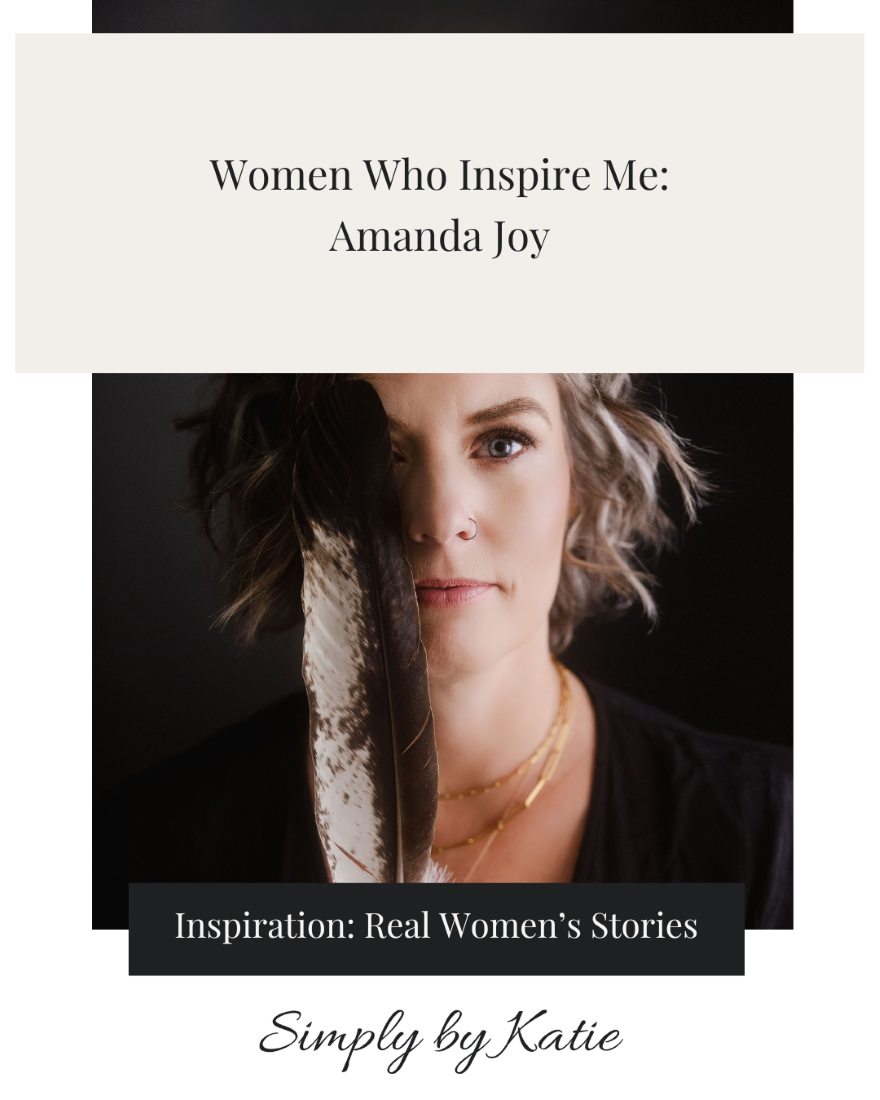
Women Who Inspire Me: Amanda Joy
What I love about this next story is that healing can look like allowing both joy and grief to co-exist in our lives. That the medicine and knowing that we need is already inside of us all. That there is power in slowing down, experiencing deep healing and becoming the versions of ourselves who are willing to get uncomfortable.
As women, we are having to navigate societal norms and expectations. Sometimes, unknowingly, they become our identity and the way that we define ourselves. Mom, wife, daughter, sister, friend, business owner, employee.
But who are we really beneath it all?
What do we like? What do we want to accomplish in our lifetime? Who do we want to be? and how do we want to make other people feel after they come in contact with us?
Before we can start this work, we need to first ask ourselves, where am I holding onto grief? Or, where am I on autopilot in my own life?
This is where I would like to introduce the amazing Amanda Joy. Amanda is a yoga teacher, retreat host, and advocate for trauma and grief healing. In the story that follows, Amanda shares her personal journey with grief and trauma after experiencing a traumatic incident over one Thanksgiving weekend and how she found her way back to herself through yoga, breathwork, and other tools to heal within her body.
Something that I took away from speaking with Amanda is that grief and trauma don’t always come from one traumatic event in our lives. It could also be from a series of tiny little things that have happened over time. The thing is, our body doesn’t recognize the difference, and oftentimes grief is held in our bodies without us even realizing it.
What I hope you take from Amanda’s story is to give yourself the permission to put yourself first, to invest in your own wellbeing, and to heal your body from the inside out.
This is Amanda’s story.
Can you share a bit about your journey, the path that led you to where you are today, and the moment that really changed things for you?
Ultimately, the message that I want for women to understand is that everything we need is within us. Sometimes it takes something in life to really uproot that, and that's where my story began.
I look back now over the last 15 years of doing the inner work, and I realized that all the tools and the passion that I have now was always within me. But unfortunately, in my life, it took a really traumatic event for it to really become uprooted and exposed.
We've got such a brief time together, and I don't want to dwell on the story itself, but in 2010, a really traumatic event happened at my home.
Through that event, it challenged the way that I chose to show up in the world.
It rocked my world so intensely that everything that I held to be true at that time was challenged.
My entire outlook on life changed.
Before the event happened, I was an avid follower of The Secret and Dr. Wayne Dyer, all those beautiful tools. You know the idea of what you put out into the world, you attract, and bring back to yourself.
Then this horrific accident happened, where a young child drowned while in my care.
Just taking a moment to honour that.
(We both took the moment to honour this beautiful soul and placed our hands over our hearts.)
Katie Eberman: Yes. I’m right there with you.
Amanda Joy: Thank you. I don't say that lightly, but I can say that now in a conversation without it shattering me, because I've done the work, and I continue to show up in the work, and some days are harder than others, you know and I have to really be in it and grieve all over again.
It was in that moment that I was challenged. I was questioning these very same tools that were bringing me this abundant, beautiful life, because I knew that I didn't attract this.
It really was a complete unravelling of everything, of just stripping me down to this raw shell of a human.
I slowly started to pick up the pieces of myself, bringing along the parts I wanted to come forward with me.
It was also a time I had the permission to shed the rest and decide, “You know what? Actually, this is not how I want to show up in this life.”
Katie Eberman: It's so interesting how, it's always something big that happens that kind of projects the rest of our story. A lot of women that I've been talking to, they have this experience of a health issue, or an accident or extreme burnout that causes them to go inwards, and from the experience, they get to see and honour their strength and that’s beautiful.
Amanda Joy: Thank you for holding that space. I often said after the accident, I wish that others could experience life through my eyes without going through the trauma that I had to live through to get here.
Because the most powerful people that I know of have been through what you mentioned, really climactic experiences in their lives that shifted their entire way of showing up. From this experience, they get the opportunity to then say to themselves, “Hey, this is a second lease on life or a renewed lease on life, and this is how I get to go forward.”
Katie Eberman: If you wouldn't mind sharing, what kind of inner work did you do or do you continue to do today to support yourself?
Amanda Joy: Yeah, absolutely. So at the time of the accident, I was a very active young mom. My kids were 6 and 9 years old, and I worked out all the time. I was doing weight training, cardio, kickboxing, and I was actually training for a triathlon with a friend. I was doing a lot of upbeat cardio workouts.
So when a dear friend of mine, who was my massage therapist and naturopath at the time, bless her heart, she introduced me to Abraham Hicks and those types of spiritual leaders, and she said to me one day, “You need yoga in your life.”
I still remember the resistance in my body when she suggested that I do yoga.
I thought to myself, “The last thing I'm gonna do is sit still and stretch. Like, no, I need to run, I need to burn this energy, and I need to punch things.”
I really resisted for about the first six months. I live in a small community, and the accident itself was really complex.
But I went forward for my children.
The first piece of advice that I received from victim services after the accident was around still living daily life amidst what had happened, because the accident happened on Thanksgiving weekend. I remember asking them, “How do I go forward? We have all these family get-togethers coming up.”
I’ll never forget what they said, and I’m grateful for their advice: “If your children want to partake in life, allow them to continue to live life.”
And so I did.
I showed up for the kids, and I kept showing up, but I really wasn't there. I was only fooling myself. Looking back, I can really see how, as a mom, when we put everyone else first, we forget about ourselves, and in turn, we become this ghost of our former selves.
What I understand now is that I was in survival mode.
I was going through the motions, but I couldn’t remember the day-to-day, the conversations I'd had, the people I'd seen, the things I'd done. I would go to take my kids to school, and I would turn the wrong way, and my son would say to me, “Mom, where are we going?”
His question would bring me out of the state I was in and recalibrate me back into the moment and remind me, “Right, ok, we're going to school.”
Katie Eberman: Thank you for sharing that because I have experienced it myself, where you are on autopilot, and really it’s your body protecting you so that you are able to move forward still.
Amanda Joy: Absolutely, it's a functional free state in the nervous system, and it’s the only way we can continue to operate when we are not ready to meet our trauma and grief.
One day I finally gave in. I phoned my girlfriend, and I said to her, “I need yoga.”
And she says to me, “Ok, we're going tonight at 5 o’clock”.
My first reaction was, “No, not today. I meant another day, definitely not today.”
Her reaction was, “Let's go.”
And so I did, and I'm so grateful for her.
Of course, it was an intense yoga, something that I related to from my high-energy workouts, a Bikram hot yoga class. I now know that it was where I needed to be in that moment, in order to challenge myself and to push through the limits that I'd created for myself.
And it broke me. It absolutely broke me wide open.
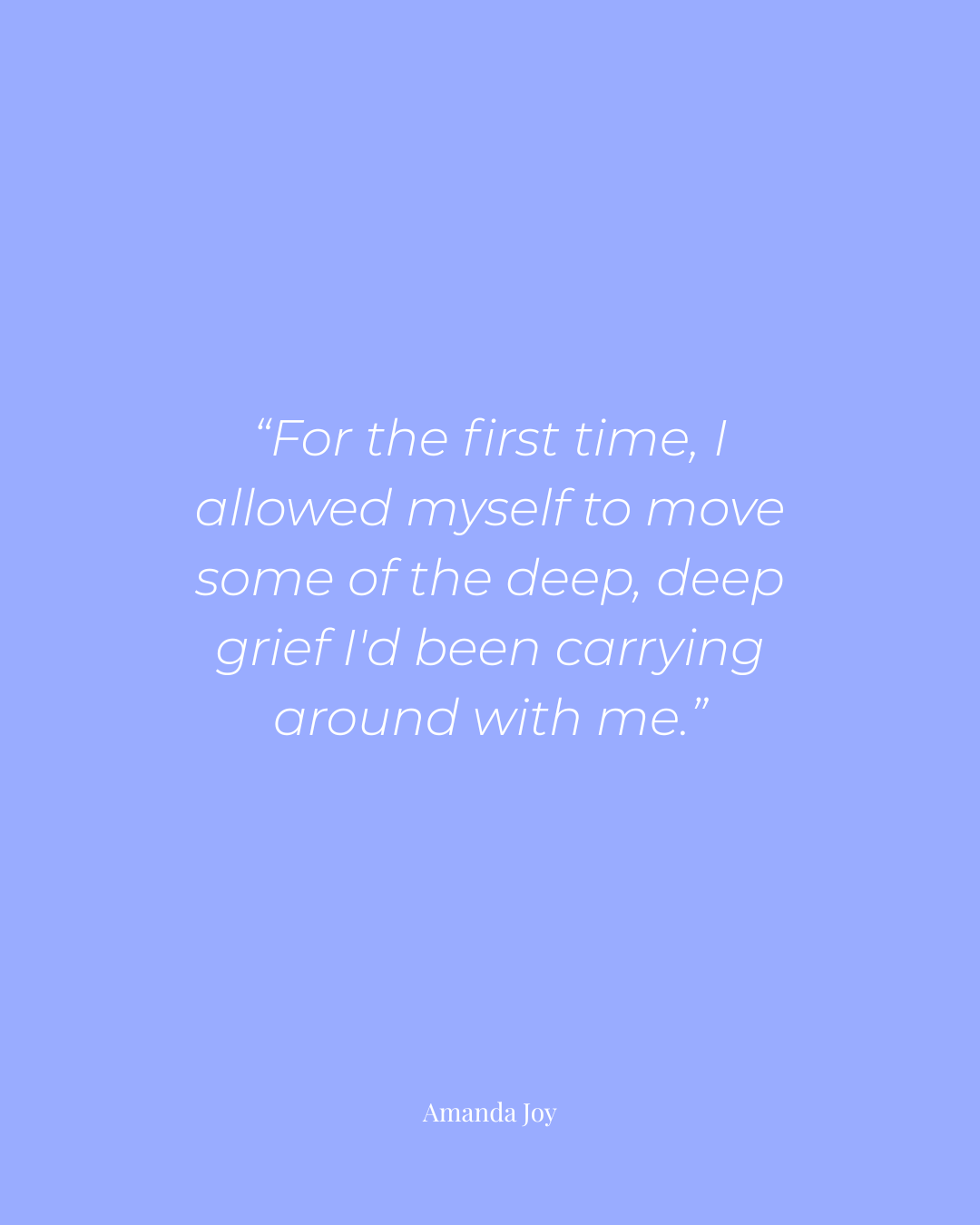
What I recognize now is that it was a somatic experience. Where I got out of my thinking mind and dropped into my body. For the first time, I allowed myself to move some of the deep, deep grief I'd been carrying around with me.
Katie Eberman: Wow, and you were literally just sweating it all out and allowing yourself to let go. When you are practicing yoga, you are in poses that require you to be strong and hold yourself up, or you're doing these crazy balancing poses. What a beautiful way to physically just shed it all.
Amanda Joy: It was really just the tip of the iceberg, but it was a step through the doorway. It was in that practice that I was introduced to a lot of energy workers.
I've met these incredible shamans who said to me, “You need three weeks, 21 days to go and deal with your own grief instead of showing up for everybody else in your life.” You know, of really committing to the idea of dedicating yourself for 21 days to create a new habit.
Katie Eberman: How did you feel when you heard them say that to you?
Amanda Joy: You know, ultimately, I still wore blinders for a very long time because I honestly thought that I was coping.
What I know now is that I was doing a lot of spiritual bypassing.
I leaned hard on that, but in doing so, I disconnected from the emotional aspect of the experience.
I held on to some of these beliefs, like soul contracts, where there was a commitment that needed to happen in this lifetime and other different ideas that really felt safe for me that were out of the scope of the human experience.
But living in that spiritual mind and energetic body, I wasn't coming back in to honour what my actual physical body had experienced through the trauma.
Katie Eberman: Oh, my gosh. It's just so layered, isn't it?
Amanda Joy: So layered, and that's where the learning begins.
When I made the commitment at first, I felt like it was impossible to spend almost an entire month away from my children. At this time, I was about 1 year into my journey, my kids were 7 and 10, and my husband was busy in our business.
Katie Eberman: Right, and it's hard as moms to admit, “I have to do this for myself”. If it were our kids or our spouses or really any family member who needed help, we would of course do anything to rearrange everything for them to make it happen. So it's a really powerful step to say, “This is what I need to do for myself,” and then allow everyone else to be there to support you.
Amanda Joy: Exactly. That's exactly the advice I give to the women who come to my retreats: “We invest in our children. Why are we not worth it ourselves?”
You know, it's the reminder that you can't pour from an empty cup.
That's essentially where I got to in my own life.
I was not taking care of myself. At that time, alcohol was my coping mechanism. It wasn't like I drank all day long, but come bedtime, and those kids were in bed, that was my go-to. To drink myself into a sleep state, so I could just turn my brain off.
But I made it happen, I found a way, and I went away for three weeks to my first yoga teacher training.
The irony of it all is that I didn't go so that I could become a teacher.
At the time, in 2012, there were no retreats that you could go on for 21 days like you can now.
I remember I flew to Mexico, and I spent 21 days in a remote little oceanfront village.
Katie Eberman: When you came out of that experience, did you feel like you had the tools you needed to move through your day, and do you feel like it was worth going on that journey? I feel like I know what the answer is going to be before you even answer.
Amanda Joy: Anyone listening who's contemplating whether or not they should attend a retreat, I say go, because for me, it was just the very beginning of my healing journey.
When I look back on the experience, it felt like deep healing at the time, but I know now that it was just the beginning, and it allowed me to function and show up again in life.
Like you said, there are these layers. And every time we peel one back, we're like, oh, good, there's another one.
Katie Eberman: Isn't that true? You are good for a while, and then something happens. In my experience, it's usually an up level about to happen. For me, I started blogging, guesting on podcasts and holding trainings because I felt ready to be visible.
In the process of me stepping into this next version of myself, all these different circumstances and lessons pop up. My first reaction is always, no, no, no. This isn’t what I am dealing with right now. I am blogging or whatever it might be. I’m not trying to heal my childhood wound, this isn’t what it’s about. I am having to realize that this is all part of the journey, and that it’s all interconnected.
Amanda Joy: Life doesn't stop, right? I always tell people that just because we're going through something doesn’t mean we have immunity to other things. Life continues on, and so we get to flow and adapt and grow along with it.
I didn't go to be a teacher. Yet when I had that experience and took all the tools home with me, I decided that I was going to teach.
When I got back, I remember I would say to every single person in my life, “You need yoga, you need yoga, you need yoga. Let's talk about yoga.”
Katie Eberman: They were all probably thinking, “What happened on that retreat?”
I mean, there is so much power in yoga, so I don't blame you at all. My mom and I have always loved doing yoga, and I have a friend who is a yoga teacher, and I feel like it’s an important part of my life, but I am always thinking to myself that the men in my life could really benefit.
Amanda Joy: I think that we're seeing more of a shift. My very favourite yoga teacher and dear friend is a male, and it's just wonderful to see him creating that space for other men. Sometimes it's not necessarily them on their mats in a practice, but it's the aspects of yoga they can integrate into their day-to-day lives that are supportive.
Katie Eberman: Right, and it's that vulnerability piece because I have two sons, and I'm always working hard to tell them, it's okay to have emotions and to support them to feel the way that they feel. When I do yoga, sometimes they'll jump in with me and try to do the poses, which is really funny to see, but I just feel like it's important that they see me taking care of myself, and then hopefully they will be interested in it as they get older.
Amanda Joy: Yeah, that's beautiful. Absolutely beautiful. I used to teach a lot of kids' classes and sports teams. It was always fun, because the little boys, once they were in the room, all of a sudden they're saying to each other, “Oh, look at me, I can do this, and I can do this.” And you make it more of a friendly competition.
It's really the connection to the body, and as you said, the key is vulnerability for everybody.
Ultimately, I would love for the men in our lives, to be able to step into that and know that it's a safe place for them.
Katie Eberman: I love that and it makes me think about how in my own healing journey, just how important vulnerability and community are to allow me to be successful and whole.
Growing up, I've always had this mentality that I can do it on my own, I can figure it out, I don't need anybody. And I did that for a long time.
When I had my kids, I went through a phase where I didn't take care of myself, I put myself last, and I hit exhaustion and extreme burnout. Over the last year and a half, I had this lightbulb realization of, “Oh, I'm not meant to do this all alone.”
So I think it's really beautiful that you create a space where people can be vulnerable, to connect to themselves and give them important tools they can bring off the mat.
Oftentimes, without realizing it, your mind can just spin, going over worst-case scenarios over and over again. When you step on the mat you have the space to let go of the mental chatter, breathe deeply and really reconnect to yourself.
Amanda Joy: I love that you talk about breathing because that was my next step. Stepping into the art of breathwork, where I could recognize how much trauma was stored in my body. It’s amazing how our breath alone can help to extract trauma in a very safe way and it’s something that we have full control over.
You know, I've also sat with some very intense psychedelics, which I am also a huge advocate for. But when you commit to that journey, you are committed to the journey.
Whereas if we utilize our breath and we can get into some of these deeper states of release, we have control over the breath and we can accelerate it, and then we can bring it back, and we can play with what feels safe for us.
Katie Eberman: It’s so powerful, I know for me that I when I get to caught up in my thoughts, I like to do box breathing. Sometimes I am doing it once in a day and then there are other days that its an integral part of my day. I would love to talk more about your retreats!
Amanda Ledieu: Yes, so I've always focused on supporting women. People have asked me if I do co-ed retreats, and ultimately, for me, I'm extremely passionate about holding space for women because I feel like it's so important to be seen and held in community.
I do have connections for men, if they're interested who can hold that space for them.
But for me, it’s about creating a safe place for women to show up fully as themselves without judgment.
So often as women, we hold ourselves back because we're fearful of, “what if I show up too confident, am I conceited? Am I full of myself? Am I too loud? Then am I too much for other people?”
Or we stay stuck in this space of humbleness and quiet, and we don't take that extra step because we think, “If I stay here, then I'm not intimidating to others.”
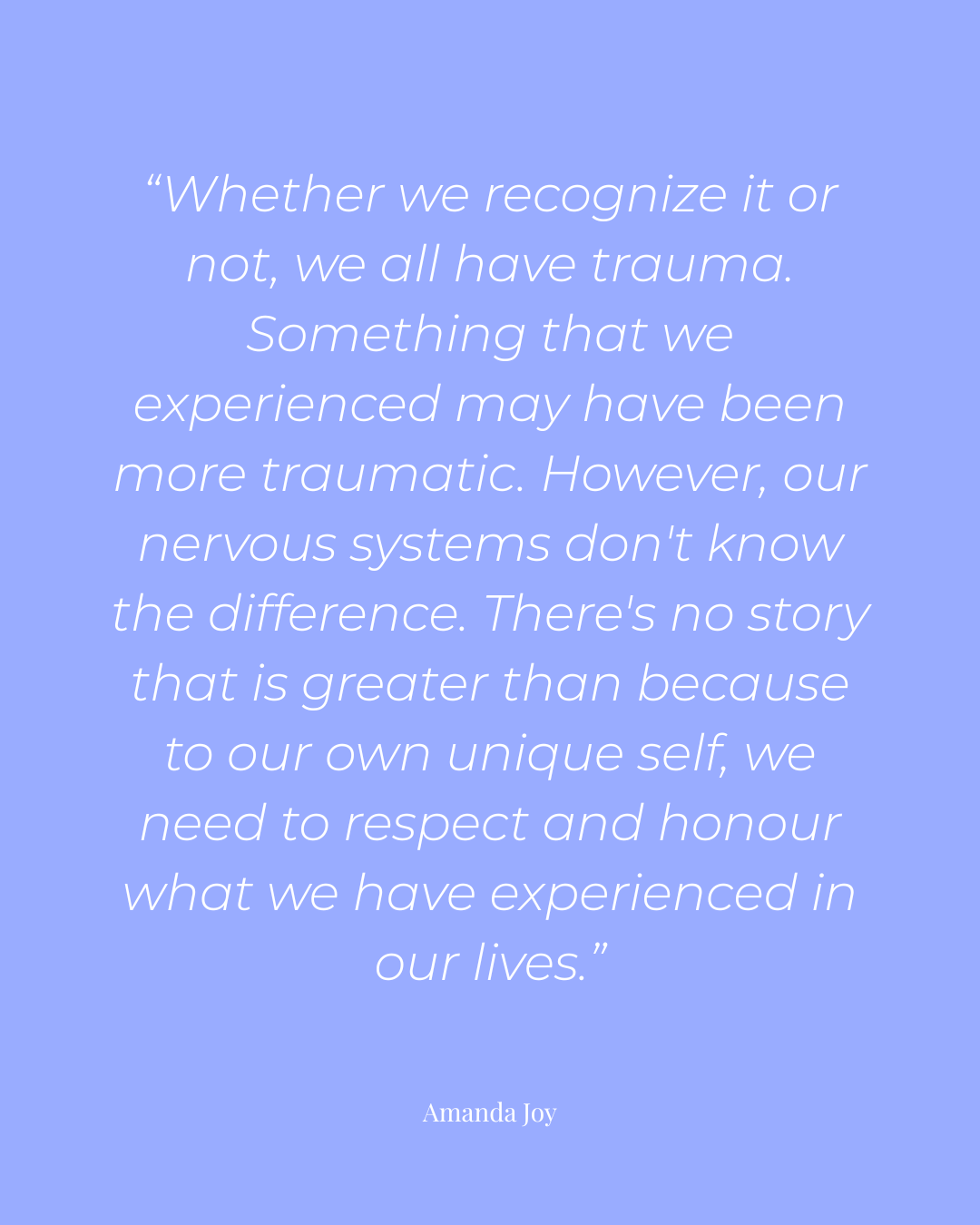
I love to assist women in really stepping into doing their own work. My retreats are always based around trauma because, whether we recognize it or not, we all have trauma. Something that we experienced may have been more traumatic. However, our nervous systems don't know the difference. There's no story that is greater than because to our own unique self, we need to respect and honour what we have experienced in our lives.
The truth is, the ultimate give-back to our children, our spouse, our careers and others in our lives is recognizing that until we take care of ourselves, we cannot truly give ourselves to anybody else.
It's so important.
And there's something about being around empowered women. It builds you up, and it lights that spark within you again. So you can show up for everybody else, including yourself, which is pure magic.
Katie Eberman: I have a question for you. So when you're talking to women to invite them into your space, what does that look like? Especially for moms.
Amanda Joy: As a mom who now has adult children, I can look back at my own motherhood journey and can truly say that it's important, it's actually integral to your own mental health to pour into yourself in the early stages of your kids' lives. I say this keeping in mind that all of our homes are their own unique experience.
You talk about having a young family, and I applaud you for recognizing that it’s important for you to invest in yourself because you know that it is important for yourself and for everyone around you.
What happens is the moms who dedicate themselves solely to their children, the home and their spouse lose themselves when that slowly starts to strip away.
I have women on my retreats who find themselves in a space where their kids have left home, and their husband works all the time, and they feel lonely, like they have no purpose.
It’s really about adopting the mindset that you are not letting anybody down by focusing on yourself. The other side of that is that there are some men who can be quite intimidated or fear that if she starts working on herself, is she going to change, and is she still going to love me?
It's really important to have the conversations with our spouses and say, “This is important for me and for us. I'm not going anywhere. This is just going to give me more purpose in our marriage to give back to you and to support us and to remember who I was before I was needed for everybody else.”
A lot of women had kids young, or got married young, or maybe they poured themselves into their parents and they never had the chance to find out who they are.
Katie Eberman: Yeah, that's true, a lot of us, for example, go off to university, then we get married, or, you know, some variation of that. But that was my story. And then it was until recently, I was like, “Oh, who am I?”
Amanda Joy: And isn't that fun? Then you get to discover all these things. You're like, hey, wait, that really fills me up. Or I used to enjoy that, but actually, that's not purposeful for me anymore.
Katie Eberman: Reflecting back on big things that have happened in my life, I think to myself, that really sucked, but I wouldn't change it.
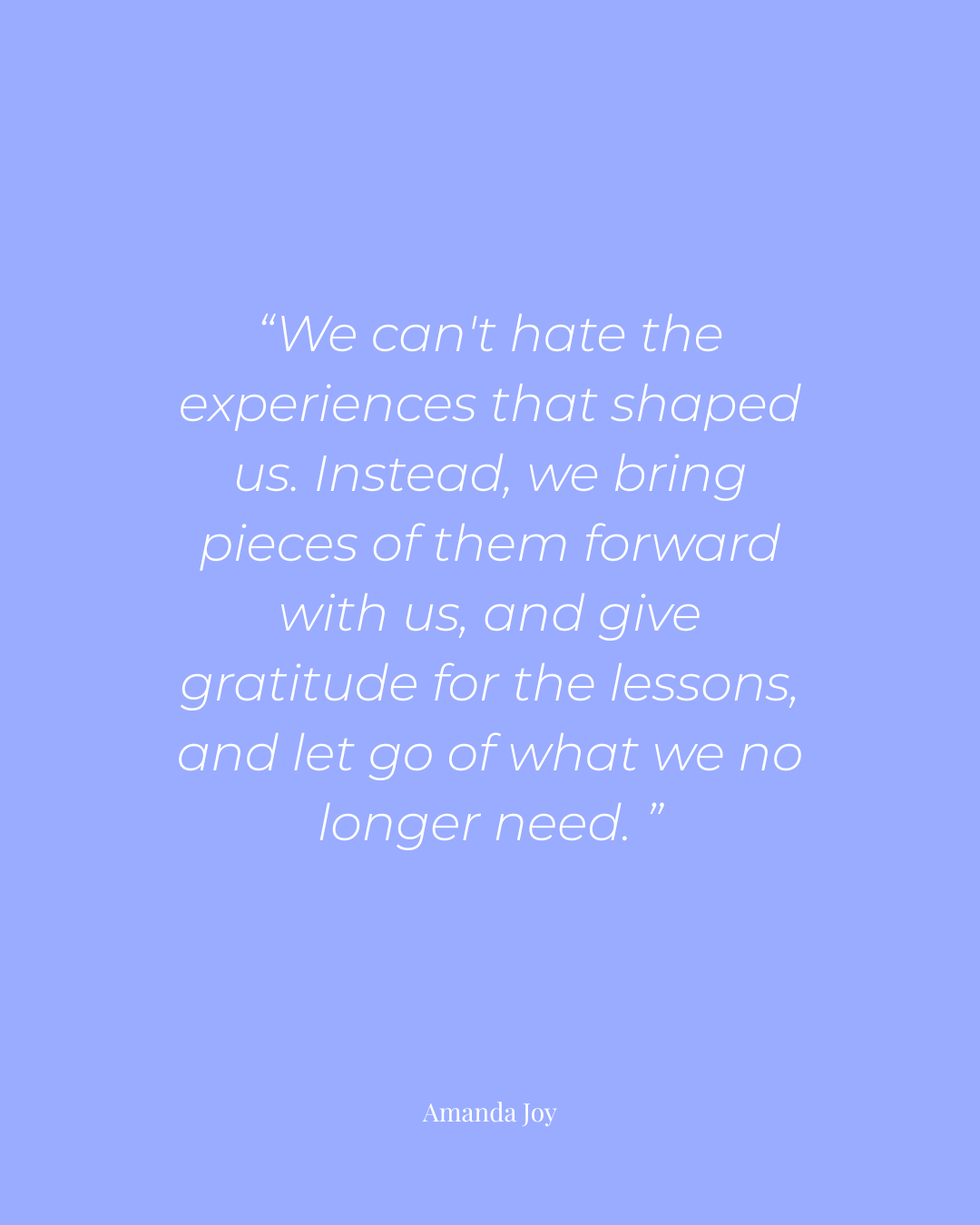
Amanda Joy: It's so true. We can't hate the experiences that shaped us. Instead, we bring pieces of them forward with us, and give gratitude for the lessons, and let go of what we no longer need.
Katie Eberman: Are your retreats mostly moms?
Amanda Ledieu: I'm gonna say about 80% are moms.
The majority of the women are in that stage in life where their kids are independent, and they don't need mom as much.
They are at the stage of life where they are asking themselves, who do I want to be now? I still have so much life to live.
My favourite breakthroughs usually come from the women who say to me, “I don't really have a story, or I'm not really working through anything.” And then all of a sudden a breakthrough happens, and they experience something that they didn't see coming. And I always say, “yes! This is why we do this work.”
I am in a transition state right now in my work, so I don't have any retreats on the calendar at this moment.
I recently have set up a beautiful space just outside of our hometown of Rocky Mountain House, Alberta. I have a vision where I'm just starting to invite small, intimate gatherings to our home.
In my transition, before I really focused on trauma, which slowly migrated to a lot of grief-centred work. Earlier this year, I completed a death doula program. Everything really goes hand in hand, and it's where the work guides me.
What’s something you’ve learned along the way that you wish every woman knew, or a mindset, tool, or practice that’s helped you step into your full potential?
The number one tool that I wish I had when I first went into my experience is the connection and relationship to our bodies. To understand that trauma, grief and big events in our lives or a multitude of small events, they don't live in the mind, they live in our bodies.
And it's through the body's response to that event or events that it shows up in all things. It's about acknowledging that if we don't deal with or learn to cope and have the proper tools in place to move this energy, it gets stored in the body.
When we suppress trauma and grief, we start to manifest illness, disease, cancer, all types of ailments, aches and pains and that indescribable feeling you have when you go to the doctor, they run the tests, and say that nothing showed up on the bloodwork, but you still feel like something's wrong.
The body speaks to us, and it's up to us to get quiet enough to truly listen to what it wants us to know.
Katie Eberman: Is there anything that you do every day that really helps you connect with yourself?
Amanda Joy: For me, what I have found to be the most impactful and what really sets me up for success is to start with the day with quiet.
Before the phone is on, and before there is any other distraction. I start my days waking up early, I love early mornings, and spend time in quiet contemplation, I call it. It's a time for me to really be with myself.
I also noticed that for myself, and this took me a long time to realize, is that moving my body is so important. If I don't have a scheduled practice, a dance party is so important to set up my day.
Katie Eberman: I love that you mentioned that, because I'll notice that myself. I'll, like, have to turn on some music and dance it all out if I can’t get away from my desk. I always feel so much better after.
Amanda Joy: And, you know, it's funny. When the kids were little, I was that mom who would sing “Good Morning!” to them. I thought I was just doing it to be an annoying mom to get them out of bed and get them moving. Then I realized how important it was for my own daily, energy to set me up for success.
When women read your story, what do you hope they walk away feeling or believing about themselves?
Working in the trauma space, I got really comfortable with being in heaviness, and I don't want people to think that when they have something heavy to carry, that their life has to always be heavy.
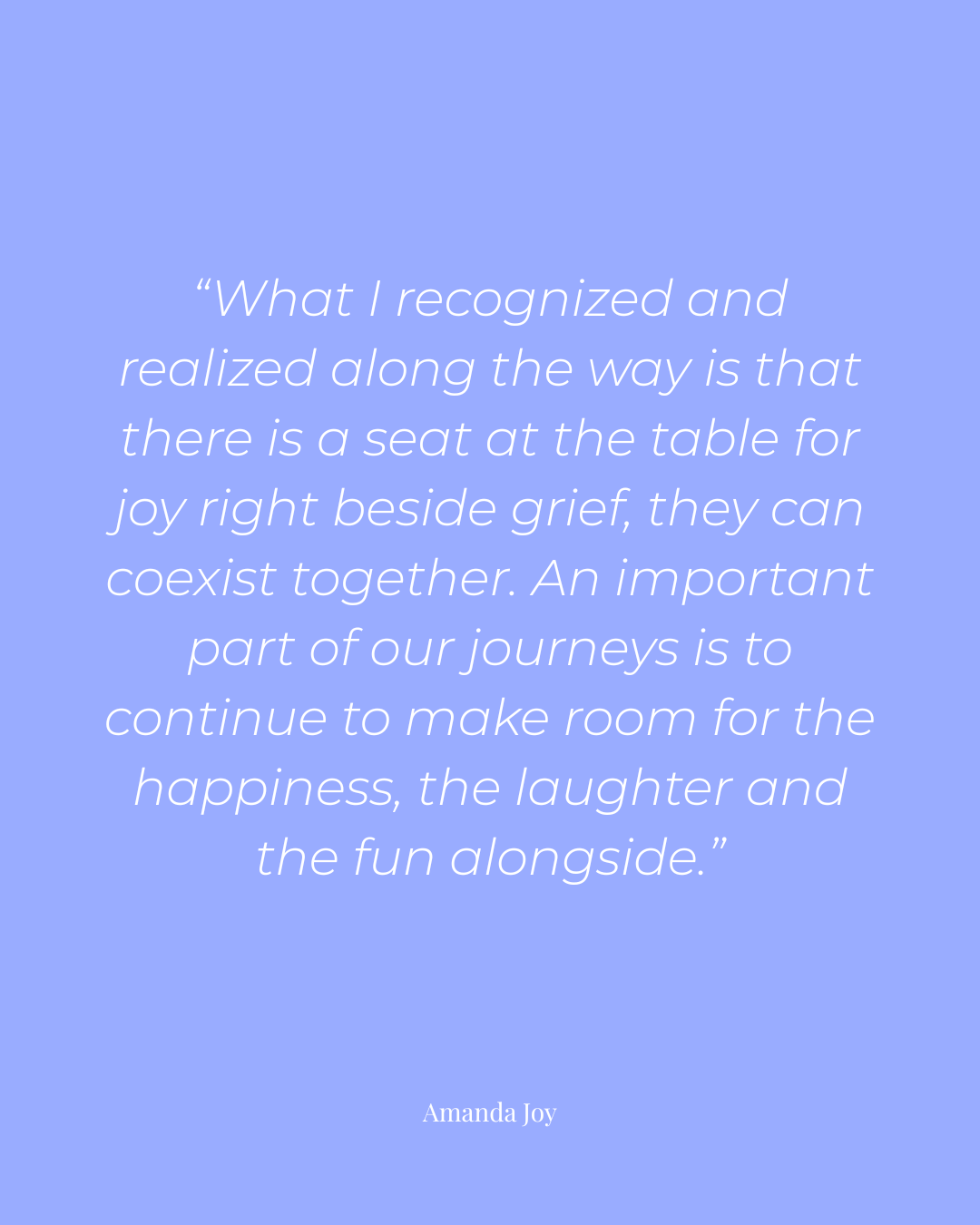
What I recognized and realized along the way is that there is a seat at the table for joy right beside grief, they can coexist together. An important part of our journeys is to continue to make room for the happiness, the laughter and the fun alongside the grief.
YOU MIGHT ALSO LIKE