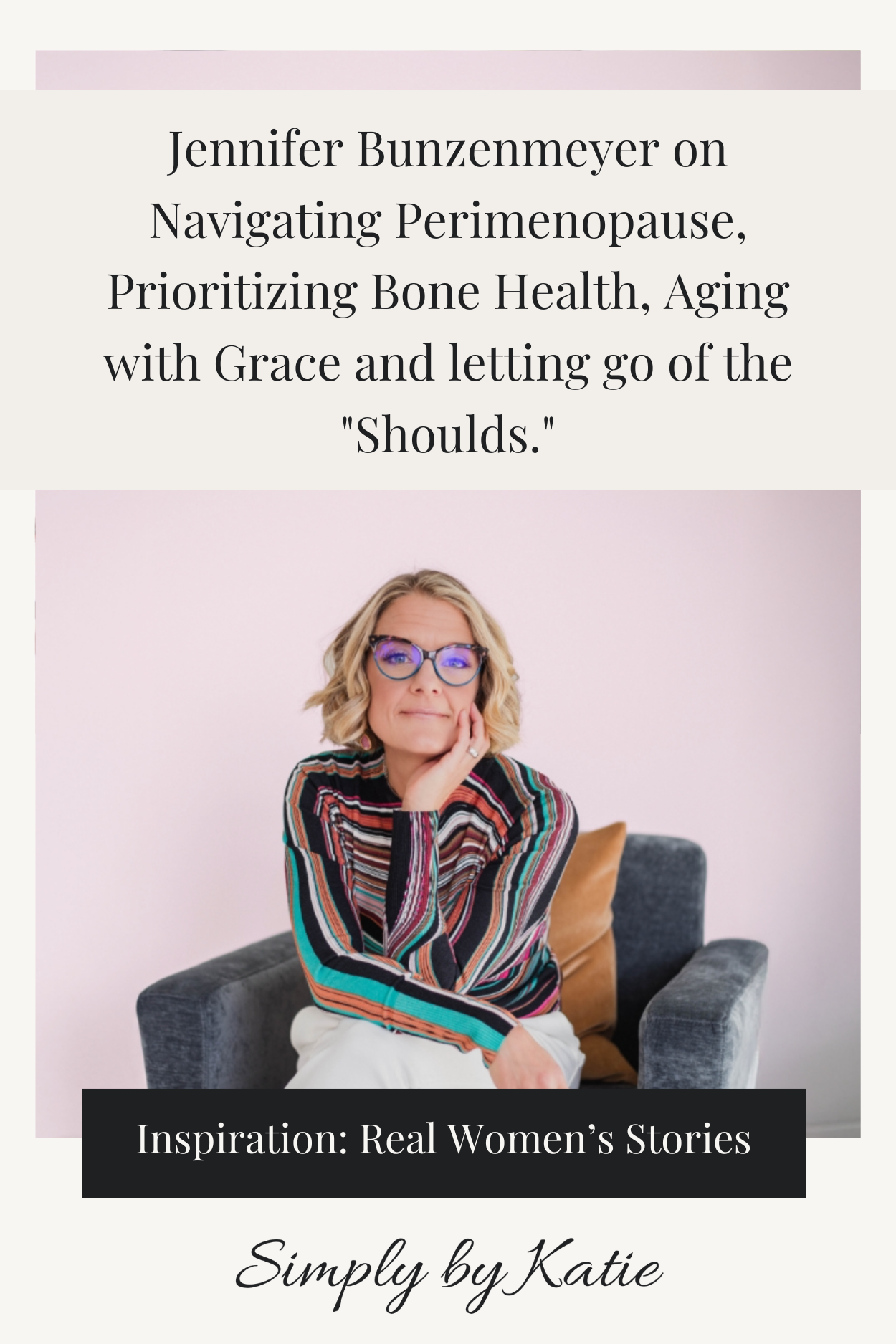
Jennifer Bunzenmeyer on Navigating Perimenopause, Prioritizing Bone Health, Aging with Grace and letting go of the "Shoulds."
Women Who Inspire Me: Jennifer Bunzenmeyer
You know when you meet someone and their energy is magnetic? How, after speaking with them, you begin to understand yourself on a whole other level? This was my exact experience in talking with the amazing Jennifer Bunzenmeyer.
I learned not only about what perimenopause is, but also how I can start to support my body after nearly a decade of lack of sleep and running after my three kids.
My own knowledge of menopause and aging is from watching family members experiencing hot flashes, and sitting across from my great-grandma over a plate of cookies as I overheard my family talk about how impressed they were that she was still walking to the grocery store at 90 years old.
A major takeaway I had from my conversation with Jennifer is how we have the opportunity to learn from the women who came before us, who wished that they knew more about bone health, sleep, and taking care of their bodies to support them in aging gracefully.
Jennifer is a Naturopathic Doctor and keynote speaker on a mission to educate and empower women to support their bodies during perimenopause.
This is Jennifer’s story.
Can you share a bit about your journey, the path that led you to where you are today, and the moment that really changed things for you?
I was always very naturally minded. My grandma and mom brought me up to aid a cold with mustard plasters, garlic and hot toddies. From a young age, I knew that I wanted to be in healthcare because I wanted to help people and I wanted to make a difference.
I went to the University of Waterloo for my health sciences degree, and that’s where I heard about naturopathic medicine. The more I looked into it, the more I felt it was in alignment with my core values of health, making a difference, and creating community for women, especially from a female perspective. I've always been connected with helping women thrive and better themselves.
I absolutely love health and anything to do with diet, using natural ways of supporting our system, and finding healing that encompasses the mind, body, emotional, and spiritual connection.
In my own journey with perimenopause, I didn't realize at that time that’s what was happening in my body. I was in my early 40s, and all of a sudden, I was getting migraines when I never had a history of migraines.
My eyes rapidly declined, going from 20/20 vision to all of a sudden needing readers. In the span of 18 months, I had to change the prescription three times.
As my eyes were getting worse, my headaches were also getting worse. It continued to progress to the point where I went from not using Tylenol for 15 years to having to break down and use Tylenol because the headaches were so bad.
I also found I was going through a lot of PMS symptoms, things like experiencing breast tenderness, weight gain, water retention, irritability, feeling really emotional, all of those types of things.
I remember thinking, "This is so abnormal for me.”
It was about six months into my personal journey of perimenopause that it dawned on me, and I finally said to myself, “Oh, my god, I'm in perimenopause!”
I remember thinking to myself, “I'm only 42.”
The thing is, the symptoms creep up really insidiously, where one day everything is ok, and then slowly we’ll notice things like, “Oh, this is weird. I have a headache.” When that is not usual for you, and you kind of push it off and keep going until you find yourself experiencing these symptoms more frequently.
Here's the thing: I was a health practitioner for 12 years, and I didn't recognize the symptoms in myself. I love to give women this message because I have a lot of women who come to me and they say, “I don't know, do you think it's perimenopause? I'm only 41 or 42 or 38 even.”
I find that, as a practitioner, we tend to attract our demographic, so I was starting to see more women in their early 40s with those exact symptoms. I was seeing women who were experiencing heavy, heavy bleeding. Their periods were so heavy that they were super iron-deficient, and it was basically controlling their life. They had to plan whether they could leave the house based on whether their period was heavy or not.
Because of the heavy bleeding and low iron, it’s common to feel super exhausted and experience extreme PMS.
When I am speaking to women about their symptoms, I always get the comment, “You should ask my husband or my kids, because that is who notices it,” or women saying, “I don't even recognize myself at that time of the month.”
What I like to educate women with is that perimenopause is a 4 to 10-year transition period. A woman can have perimenopause symptoms at 38. It's totally possible.
When I finally realized what was happening for me, I started researching like crazy. There's nothing like when it's happening to you as a practitioner. I already do a lot of research and am very analytical for my patients, but when you're living it, it's like a whole other level.
At the time, I was looking at evidence-based medicine, which there was not a lot of research on at the time. This was almost 10 years ago. I looked at integrated medicine practitioners in the field doing amazing work around hormones, and I started to glean the wisdom of how to support the women who were seeking my help.
From my research, I started to figure out that there were foundational elements of care that needed to be put in place for women to thrive. This is where I developed the Bunzenmeyer Method of Hormone Reset, a methodology of how to support women through the four pillars of care.
Pillar one is all about the basics. I figured out I need to get women sleeping and to get their energy levels up. What's happening is they are starting to wake up at 2 or 3 in the morning, and having a hard time falling back asleep. They are then waking up exhausted in the morning, pressing snooze, skipping their workouts, and experiencing low energy and brain fog throughout their day.
Pillar two is about looking at gut health. There is a huge connection between hormone metabolism in the gut and the breakdown of hormones. For example, in menopause, our bodies start getting more inflamed, and if our gut is inflamed in our 40s, that's going to continue as we get to menopause.
Pillar three is looking at all how to support our hormones - progesterone, estrogen, testosterone, and cortisol.
Pillar four is focused on having the tools we need to support us and allow us to age as gracefully as possible.
That's my goal, because I have a lot of women who are coming in at 65 with osteoporosis and Katie, every single one says, “I wish I had done X, Y, and Z when I was in my early 40s.”
It really lit a passion within me to educate women to understand what to watch for and then to start building tools in your toolkit to help support you all through the latter part of your 30s and all through your 40s.
Katie Eberman: Oh, that's amazing. I've just learned so much from what you just told me. Honestly, the only thing I knew about menopause was that you're hot. Like, that's it. I had no idea that perimenopause was something that women experienced until recently.
Jennifer Bunzenmeyer: That's exactly it, we don’t know until it’s too late. A great question I get is, “What can I do in perimenopause to support myself?”
My answer to that is, when we think about menopause, we think about hot flashes, weight gain and mood swings.
That's what we're educated about, and that's what we've heard our moms complain about, but we haven't learned how to support ourselves as we head into menopause.
As we go into menopause, we become more susceptible to certain diseases because we are experiencing a lowering of estrogen. So we become more at risk for heart disease, strokes, diabetes and insulin resistance (which is linked to weight gain), Dementia (because estrogen feeds our brain cells), and then we have osteoporosis, or bone loss.
That's why my methodology is the way it is. I want to prevent these major disease risk factors by teaching women what to do so they're not thinking at 65, “I wish I had done XYZ.”
I'm a firm believer that if there's something we know we should be doing, and we find ourselves not doing it, there's always a valid reason why.
Whether it be that you're so exhausted because you're not sleeping, and that is causing your diet to go off track.
Or it’s your gut health, your microbiome, the flora in your gut is off, and then that's causing cravings.
There's a reason why things are happening, and that's what we need to get to the bottom of.
Katie Eberman: I love how you start with sleep because, for me, I have three young kids, and I have not slept in seven years, and I can see that when I don’t sleep properly, I’m not feeding myself properly.
Jennifer Bunzenmeyer: Exactly. The women I am supporting have just spent the last 10 to 15 years raising their kids. They are usually the ones who were getting up with the kids during the night, and often find themselves in this place of having high cortisol levels.
In our early 40s, what starts to happen is our progesterone starts to decrease. Progesterone is anxiolytic, which means its job is to calm us down.
On top of that, I call it our resiliency gas tank, which has to do with our adrenal glands or stress glands. They have worked really hard all throughout our 20s and 30s, where we are learning how to be a parent, potentially building a career and multitasking a million things daily.
That resiliency gas tank starts to decrease, and this affects our nervous system, where we become more anxious.
There are lifestyle things that we can look at, for example, your routine. When everything is in routine, your adrenals don't have to work as hard because they are in status quo.
We can help fortify the adrenals with adaptogenic herbs or a B complex so that you have better energy and resiliency.
For a woman who is waking up in the middle of the night, I can do cortisol modulating herbs. Certain herbs, like magnolia, have a nice calming effect on the system and modulate cortisol.
What’s something you’ve learned along the way that you wish every woman knew, or a mindset, tool, or practice that’s helped you step into your full potential?
Perimenopause is a four to ten-year transition period, so what that means is that the average age of menopause is 51 years old. We don't exactly know when a woman is going to have her last period. It might be at 51, it could be at 50, or it could be at 48.
Let’s say they end their period at 48. That means that they could start perimenopause anywhere between 38 and 40 years old.
It becomes more important to be aware of your body from your mid-30s onward, and watch for symptoms that are out of the ordinary for yourself. If something starts changing that's not usual for you, that's the first symptom that I would look at.
For example, your period starts to get heavier, or I would say PMS is a big one that starts to get worse. PMS could be anything from irritability, anger, feeling emotional, mood swings, breast tenderness, weight gain, and water retention.
The better you know your body and the more you're paying attention to how your body is feeling, which I know can be difficult in itself, because we are so busy doing a million things a day that we might not recognize those symptoms right away.
I say be graceful and compassionate with yourself. When your body is talking to you, listen, if you can.
Then talk to your medical doctor about your symptoms, because medical doctors are primary care physicians. Then build your healthcare team, one that works for you. I think it's important for everyone to have their healthcare team, one that is evolving depending on where you're at in your life. You get to decide who you want to be on that team of yours, whether that's a naturopathic doctor, physio, acupuncturist, psychologist, or therapist. You get to choose based on what you feel you need at this time.
In Alberta, naturopathic doctors are regulated health professionals. A couple of ways to find a naturopath in your city are to do a Google search, where you type in “Naturopath Calgary” or “Naturopath Edmonton”.
Or, you can search the Canadian Association of Naturopathic Doctors, where they have a list of registered naturopathic doctors available to you.
When women read your story, what do you hope they walk away feeling or believing about themselves?
There are two messages that I want to make sure that women know about. The first one that I'm really passionate about is bone health. I feel like bone health is not talked about enough, and we don't realize what happens in our bodies as we age.
A resource I read said we start losing bone in our late 20s, and that continues to decrease in our 30s and 40s. One thing I do want to highlight for women is that we lose, wait until you've listened to this stat, in the 10 years around our last period, so again, we don't know when that's going to be, but say it's 49 years old, we're losing 10% of our bone. It's a lot.
In the three years around our last period, which again, we don't exactly know when that is, we also lose a ton of muscle.
I'm on a mission to let every woman in the mid-30’s to early 40’s know they really need to work on their bones by the age of 45 years old. I always say, even if you are a woman older than 45, it's never too late to start.
Weight training becomes very, very important. We want to be lifting really heavy, as heavy as we can stand, to eight reps, three times sets.
I also counsel women on making sure they are getting enough calcium in their diet, because when we're in our 70s and our 80s, it becomes a real issue, because that's when we are more frail, and we're more susceptible to hip fractures. Hip fractures lead to mortality, especially in people in their 80s.
My last message is from a vitality perspective. My whole program is about how to build energy, how to support stress management, and how to live as vital as you can.
I wholeheartedly want women to walk through the rest of their lives with the confidence that they have what they need to move mountains and accomplish what they want to do.
My message to women is to really connect with who you are, like who you really are, not who you should be, but who you really are and do the inner work. The inner work to let go of these shoulds and instead be in full alignment with who you want to be.
Let go of the, “But I should do this”, the stories you're telling yourself, the negative aspects. Do that inner work. Hire the people to do that. Work with psychologists, therapists, coaches, whoever you need. And then do your reading, do your self-development, so you can move mountains and continue living in alignment with who you want to be.
Life is too short. Let's live how we want to live and create the life that we want.
Here’s how you can connect with Jennifer: