Jenn Wolowich on Finding Peace in Co-Parenting, Reconnecting with Who You Are, and Helping Others Reach Their Financial Dreams
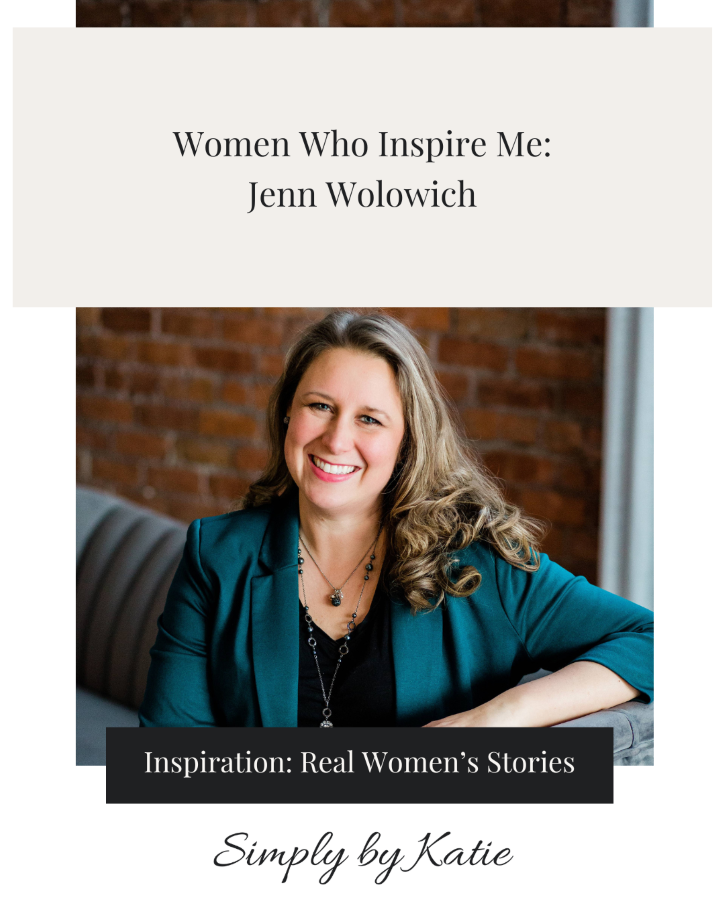
Women Who Inspire Me: Jenn Wolowich
One thing I think we can all agree on is that for many of us, money is emotional. There are such intense feelings associated with money. Whether it be shame, guilt, or joy, we have all at one time or another tied so much meaning to money. We may define ourselves as being bad with money, or a saver or a spender, but what if money were just a number, with no emotion attached?
Where instead we don’t get stuck in valuing ourselves or measuring our worth by the number in our bank account. Now I know this is so counterintuitive and goes against the way we have built a relationship with our money. I share this because it’s a journey that I am on myself.
I am determined, though, to use money as numbers in my spreadsheet that allow me to do incredible things in my life for both myself and for the people I love.
I have big dreams, and they require money to achieve. Of course, my dreams require more than money, but for me, the key lies in getting comfortable with making and investing money in myself. That doesn’t come naturally to me, but I'm getting better at it.
Before I started my own journey, I always thought of myself as good with money, and I still believe that to this day, but it was always something that I would hide behind. I would see the number I needed to achieve something I wanted, and I’m not going to lie, I got intimidated.
I also questioned, "Who am I to want to do these big things in my life?” It turns out, I am just the right person to go after her dreams.
This is where I would like to introduce Jenn Wolowich, a Certified Financial Planner helping Canadian families achieve financial security. What I loved about our conversation is how many similarities to my own story we shared. Jenn talks about how early in her career she felt like she was trying on different paths for herself until she settled in as a financial advisor, a career she truly loves. She shares her experience with divorce, and what healing looked like for her as she built the tools to support herself as she navigated the feelings that come with a first breakup, and why she loves helping people just starting out on their financial journey get closer to their dreams.
This is Jenn’s story.
Can you share a bit about your journey, the path that led you to where you are today, and the moment that really changed things for you?
Umm, I don't know, with my love of Monopoly? (We both laughed here).
You know what, I feel like my journey is similar to others in that we just think we know where we're going until it's not where we're going anymore.
I've always kind of just moved forward confidently towards the things that I’ve wanted to accomplish, and sometimes when I’ve been close to making it happen, I have found myself taking a U-turn, or coming to a fork in the road.
I’m the type of person who, when I make a choice, I proceed to do the things required to get to where I'm going. At the same time, the number of times I've gotten to where I wanted, and then found myself thinking, “No, not here, this isn’t it,” is a lot.
I went to post-secondary to be a geophysicist because at the time my parents owned an oil and gas company. My dad gave me the advice to go become a geophysicist because it was the most logical profession that would allow me to be successful in the industry, and to take over the business.
Partway through the program, I found myself thinking, “It doesn't matter how good I am at this; rocks are just not exciting.”
You see, I am very, very good at school, but physics is not my jam. I can do science and win an award. I can do math and ace the class, but if you try to put math and science together and make an object move, my head explodes.
So I ended up changing and got my degree in psychology. I joke about it now, but I might be the only one to stand up with a Bachelor of Arts, whose electives were calculus and advanced algebra, but that's just the path I was on.
By the time I graduated, I had a job working in a showhome selling houses right when things were booming. I felt like, here I am, with the best job ever in the middle of a real estate boom.
I look back at that time in my life where there were a lot of changes and pivoting, going from geophysics to psychology, to, oh, just kidding, I’m selling houses, it was a time of discovery for me.
I thought that this was going to be my career.
But at the same time, I was married, and I had a baby, and I just thought to myself, "Nope, this is it now. I'm staying home to do this.”
And so I did. At some point, I thought I'd like to get a real estate license, and it turns out selling show homes is nice because a cleaner comes through, and you know everything about the property; you can open all the doors. It’s predictable.
When you're selling as a realtor, you walk through people's houses, and not everyone keeps them like a show home. I quickly realized that wasn't for me.
What I liked about working in the show home was I could go to the suppliers, I could learn how they made your windows, I could learn everything about the products, I could tell you about all the warranties, and all of the things, versus walking into a previously owned home, where there are no warranties, I actually don't know who did the work, and I didn't get to walk through before the drywall was up.
And then, you know, in trying on all these different industries and roles, I became a Certified Financial Planner, and it has been the most natural fit.
It allowed me the opportunity to continue to be the school driver for my kids and volunteer as much as I can, but also have a career doing something that I actually love.
It really is a privilege to be walking with people through their finances.
My favourite clients are always the ones who are a little bit uncertain and a little bit scared, because kind of like when I was selling houses to first-time home buyers, they're excited and optimistic about what is ahead.
Making that leap to buy your first home is very much like making the leap to say, “I actually am not sure what I'm doing, and I need to hire help for my finances.”
While I have clients with $500 to clients with millions of dollars, those who are just starting - my gosh, they hold a special place in my heart.
So my journey kind of feels like a ping pong ball, and you know, all the while, everything was quite linear.
Like I said at Trailblazer, I met my high school sweetheart when I was 15, we got married, and then I had my first breakup ever in my whole life at 37 when I got divorced.
Katie Eberman: That's me, too, so I completely understand.
Jenn Wolowich: Yeah, and I had no breakup skills. I remember thinking, “I don't even know how to do this.” So that was super fun.
Katie Eberman: Right, and asking yourself, “How do I even navigate this?”
What’s something you’ve learned along the way that you wish every woman knew, or a mindset, tool, or practice that’s helped you step into your full potential?
Having gone through that experience, I feel that it’s so important that you know your money.
Even if you're in a relationship and your partner is managing it, you still have to know it.
For me, this is my job, and I knew my money very well, and it was still scary.
So to go into it knowing nothing, which I have many female clients, male as well, who will go through a divorce and don't actually know because their partner always did it. I can’t say it enough, we have to know it. Even if we don't do it, we just have to know it.
Katie Eberman: Just having that knowledge of, ok this is where my money is going, and this is the best way to use it, so I can reach my goals and have safety too.
We don't get that type of education in school, so it’s really a self-taught skill. I know for me, it’s not something my family really talks about. It’s more conversations about what not to do with your money.
So I can imagine that for your clients, it's really the first time they're coming to someone and really opening up, and saying, “I have no idea what I'm doing.”
Jenn Wolowich: Absolutely, and I mean, not knowing what's happening with your money is not really a great feeling under any circumstances, but in the middle of a divorce or a death or an illness, that is a crippling feeling.
Katie Eberman: To share a little about my own experience. I knew about our money, but because I was a stay-at-home mom, I had very little income coming in at the time of my divorce, and I was in a spot where I felt like I didn’t know how to make money and be the sole caregiver to my kids. I was home for five years, and I felt like I didn’t have any skills to bring to the workforce anymore. It was a lot to navigate all at once.
Jenn Wolowich: Well, it's intimidating. Similarly, I was home for 10 years. It's really intimidating to realize that you need to go and make an income after being a stay-at-home parent for any length of time.
Just in terms of feeling your way through a divorce, there's such a terrible and unfortunate stigma around spousal support.
You know, child support is pretty cut and dry. Even though there still could be some dispute about it, the rules are the rules.
It's a mathematical calculation. The court will step in, and they will do all the things.
But spousal support is really a gray area. I know that I've encountered some clients where they will push back, and they have this feeling of, “I don't want to take this money. I can do it on my own”.
I really want women to see it a little bit differently because, don't get me wrong, I also wanted to be like, “I don't need anything, I can do this by myself”. But the way I look at it is when you sit down to get a divorce, it's a financial transaction, and we divide assets.
When you have one spouse who's worked and one spouse who hasn't, that job becomes an asset of your marriage, and they need to buy you out of it.
Right, so for me, it is not support.
This is you buying me out of an asset that I helped you build. He can't split his job in half, and his job certainly had no interest in me showing up 50% of the time to earn wages.
But this was our family asset, and he was taking 100% of it, so he needs to buy me out of that asset.
I really worked hard on that perspective. So when it came to dividing assets, I had to buy him out of the house because I was keeping it, and he was keeping the job, so he had to buy me out.
We really worked hard to walk the path of what was mathematically correct, and to save our feelings for the psychologist's office.
Katie Eberman: It's hard to do because feelings do come into play, and either you don't take what you deserve, or there's just a lot of fighting.
Jenn Wolowich: It's a tense time for everyone, whether you've chosen it or been told it's happening, or even if it's a mutual decision. There's uncertainty because you're about to establish a new normal. Everyone in the situation, whether they're employed or unemployed, is worried about whether they're going to be okay moving forward.
So if you're the payer of support, whether it's child support or spousal support, you're worried you won't have enough money to get by yourself.
If you're the receiver, you're also worried about having enough money to get by.
Part of it is just transparency and making sure everyone has all the same information. So that decisions are being made from a place of honesty and integrity.
For example, if you're the payer of support and you are thinking, “Well, after I pay my support, I'm only going to have $5,000 left,” and if you are only paying out $2,500 in support, and you can't make it work off $5,000, how are they making it work off $2,500?
Katie Eberman: I’ve experienced that myself, and I have also found that when emotions are taken out of it, and it's just simply looking at calculations, it's been a lot easier.
Jenn Wolowich: Exactly, and I really don't know people who walk out of a divorce saying, "This was a great financial decision. I'm so wealthy now.”
We have our reasons, but, you know, it’s important to also remember that it’s just a moment in time.
For me, I wrote a lot when I was first separated. I always kept in mind that anything I wrote about and shared, my children might read it one day.
If I shared it on the Internet, I needed to make sure that everything I wrote about, I would be okay if they read it. Knowing that the other half of my story is someone they love.
What I did by sharing it was I took away the embarrassment and the shame.
I think it's getting less and less shameful, but it's still embarrassing.
I want to be good at everything, and getting a divorce had me wondering if that meant I was bad at marriage?
It takes work and support to recognize it didn’t mean I was bad at marriage. It simply meant I was in a marriage with the wrong person.
But those first moments, because I was voluntold I was getting a divorce, it was a really painful experience.
It's not that I had any intention of harming myself, but it was just so painful. It just felt like I’m probably going to die from this because it hurts so bad.
And then you don't. You don't die.
I think that an important part of sharing our stories is that when we're able to see ourselves in someone else's story, it allows us a moment to go like, “Ok, well, she didn't die. Actually, it looks like she's doing just fine”, and then we can get inspiration and comfort from that.
Katie Eberman: To add to that, when you see what success they've been able to bring into their life or peace or whatever it may be, it gives you a little bit of hope and encouragement to say to yourself, “I can do that too.”
Jenn Wolowich: Exactly, something I did early on is I set a reminder in my phone about six, seven years ago, right when we separated, to go off at 7:45 every morning that says, "How will I be living in Joy today?” Because I knew that every day I woke up, I had a choice. I didn't get to choose necessarily where I was at in that moment, but I got to choose what that day brought.
Sometimes, how I lived in joy was in those tiny little moments where I had to think of 10 things I'm grateful for. And sometimes I had to dig to the bottom of the barrel to be like, I'm alive, and I have a warm blanket.
Something I want to encourage women with is that even though the experience is painful and it’s hard, it turns out sometimes in the end, we end up better off.
Katie Eberman: I love that you share that, because it is similar for me. Among the heartache and finding my new normal, I had to find small ways to ground myself. So being grateful for having warm clothes or having a car to get the family around in, those small moments really help build my confidence to get me to the bigger things.
For example, Trailblazer. I just knew I was supposed to be in the room, and I remember I saw the price and my immediate reaction was, “Oh, I can’t spend that type of money on myself.” And so it took me a few weeks to even, I guess, talk myself into it, but it really came down to: if it were the kids, I would 100% make it happen without even thinking twice about it.
Jenn Wolowich: Yes! Learning how to spend money on yourself is weird. So spending money on myself was something I was never very good at. Just like you said, if it's for the kids, I figure it out. If you're surprising your spouse with something, yes, all day long.
Something big I did for myself that I want to share about is that I turned the bonus room of my house into my office. I claimed the entire space. I was like, "This is now mine. This is for me.”
At first it felt obnoxious that I just claimed the whole giant front of the house for myself, vaulted ceilings and all.
But then I made an income goal for myself that when I got to six figures, I would commission a painting from one of my favourite painters, Serge Dube. I just love his paintings. I have custom-made cabinets and a granite table top. I had an electrician come in and put in lighting above my painting.
And I created an entire space just for me.
It was uncomfortable for me to claim this space and be ok with spending money on myself. I had a plan, and it didn’t take away from any of my or the family's needs, but it was still uncomfortable.
I even went to Lazy Boy and got these fancy-looking chairs that don't look like recliners, but they recline. And then I got this obnoxious light fixture that I fell in love with in a show home.
Every day I come into this room, and it’s become the place where I generate the revenue I need for my family and for me, because I am capable, I am smart, and I can do it. It’s also the place I get to create financial plans for the clients I adore to achieve their goals and dreams too.
Getting a divorce meant figuring out who I was by myself and contemplating tough questions. Sharing custody meant wondering if I was a mom on the days my kids weren’t with me.
It's been a journey.
There are definitely times when we go into the summer, and just the way the kids' schedule works out, I might not have the kids for three weeks in a row. That still sucks.
There's still that initial moment at the beginning of the three weeks where I'm like, oh, this feeling again, but it goes by pretty fast now.
When my kids would leave on Mondays, I would come home, clean a little bit and cry in one of their beds until I fell asleep.
And after a decade home caring for the kids, I had to get a job. I had to figure out my income. I had to do so many things, but I also had to let this experience happen, and I had to leave room to feel my feelings.
So Mondays were for feelings.
And honestly, some days I literally just laid in their bed. Or I had a bath. Nothing ever really happened on a Monday for a long time until it did.
I started figuring out what I liked to do again.
I just started to say yes to everything. Part of it was because I didn't want to be alone. But if someone's asked, “Hey, you want to go eat? Or I've got a concert ticket, do you want to go?” I said yes to everything just to figure out, do I like doing this?
I found out some stuff I don’t like, and some stuff I really do like. A lot of those feelings don't even happen anymore because I just said yes to start figuring out what I like and who I am. And also knowing I'm a mom 100% of the time. Just sometimes, my children don't sleep at my house.
Katie Eberman: I appreciate you sharing that because I have had those very same thoughts, and just overwhelming feelings of questioning who I am now, and navigating co-parenting, where I’m used to having my kids 24/7 and then adjusting to my kids spending time with their dad.
Jenn Wolowich: And when they return after you’ve had time to yourself, you're legitimately grateful that they're back because you are rested, and now they get a better version of you.
Katie Eberman: Yes, 100%! It's an empowering feeling to come back to yourself again and feel like, “Oh, I can do anything”. And when you're ready for another relationship, you have more standards for yourself, and you know what you want moving forward.
Jenn Wolowich: I remember asking a couple of girlfriends, “How do you know when you're ready to date again?” And they said, "When you are happy being alone.” I thought it was the stupidest thing I've ever heard.
But they said, “Until you are okay being alone, you will be looking for someone to fill a void. And once you start to enjoy your alone time, you're no longer seeking a partner from a wound. You're seeking somebody who will add value to your life.”
Their time with you has to be better than your time alone. As opposed to just, “Oh, I'm in pain, and you being here distracts me from that.”
That's not the next relationship you want.
And they were so right. It took me a long time to be okay being by myself, but what a beautiful gift it has been.
When women read your story, what do you hope they walk away feeling or believing about themselves?
I just want them to know it's going to be okay. There are so many hard things in life, and women carry so much of it. Whether it's aging parents or stressful kid situations. There's so much, and it's going to be okay.
Our legacy, it doesn't lie in our possessions. It is found in our relationships. When we nurture those relationships and the wisdom that we share, we are providing joy, comfort, guidance and inspiration. That is our legacy.
Sometimes we just need someone else to tell us: we're going to be okay.