Julie Sedler on Redefining Success, Modeling Healthy Relationships, and Building a Business in Your Own Way
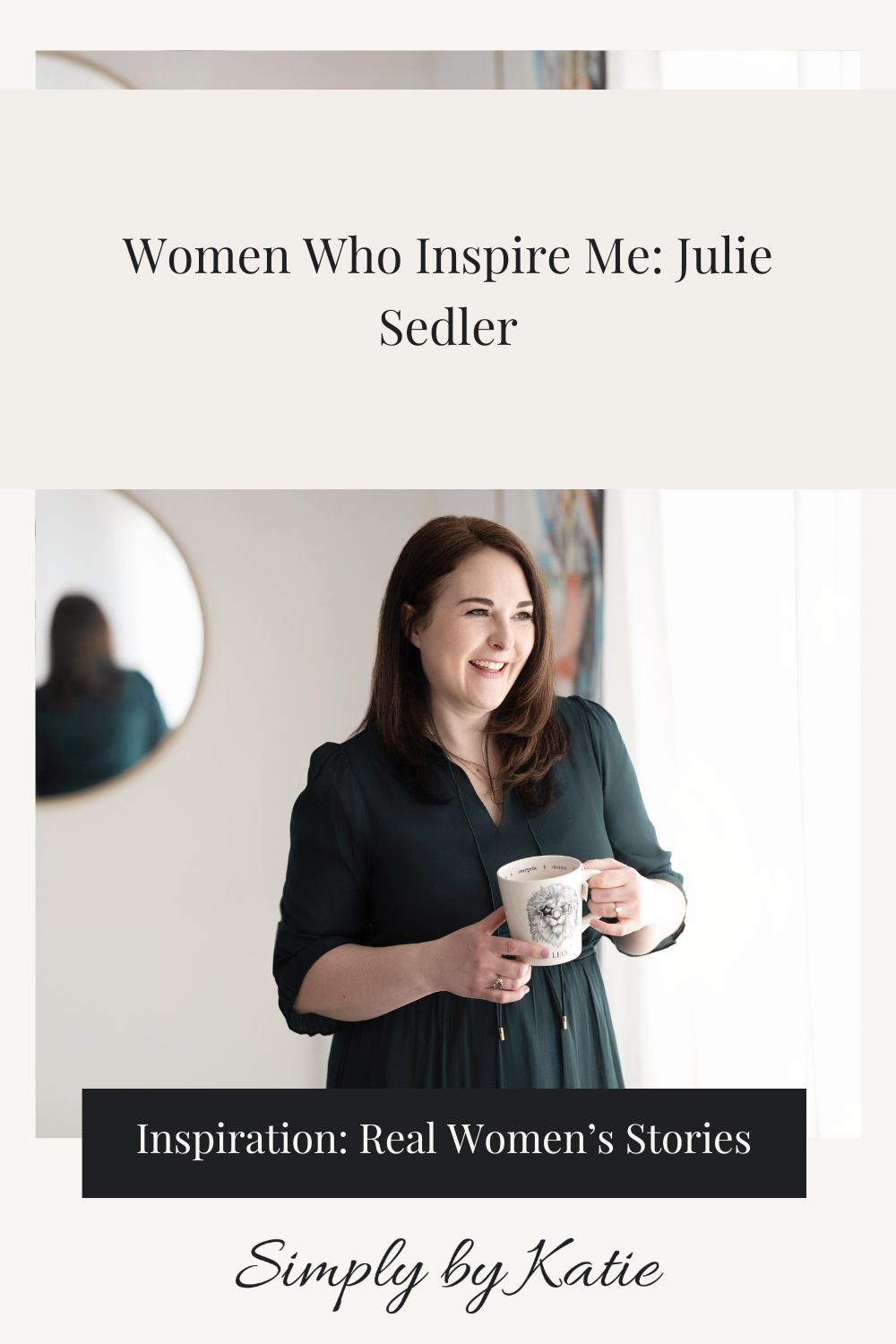
Women Who Inspire Me: Julie Sedler
What began as an experience in a room where women in business came together to share their stories in a safe space became the inspiration for this series. A series that highlights the stories of the women who inspire me. Who are building a different path for themselves in pursuit of their dreams. Modelling what it looks like to go first, and not just the curated highlights reel, but the truth of what it’s like to create something that only they can see. Where we are not failing if in our first years of business we are not making six figures, and oftentimes our reality is showing up to calls with our kids in the background because it’s real life we’re living in.
I first heard Julie’s story as I was spending the afternoon listening to the Worthy Mother Podcast, now the Sparkle Project Podcast, while I was tidying up the house.
I remember reading the episode title “Raising Kids and Rebuilding Yourself After Divorce With Julie Sedler” and thinking to myself that I needed to hit play, because it was exactly the conversation I needed to hear after going through a hard transition myself. One I never expected to ever go through, but the dissolution of a fifteen-year relationship.
As I listened to the episode, I appreciated the realness of the conversation. How Julie opened up about something that I was too afraid to speak about out loud, because in my circle of peers, this was an experience no one else had walked. I listened to how Julie spoke about writing a book about her journey with waking up one day and finding herself in a life that didn’t feel like hers anymore. Where she was in a marriage that no longer fit her, and her courage in making changes as a mom of two young children. She spoke about pivoting from being on constant autopilot and instead how she rewrote the stories she had for herself. One day at a time, she chose the path of healing and self-discovery, to choose differently, and to create a new, intentional life.
I related to the feeling of getting your own place after being separated, and how special it was to create a sanctuary for ourselves and our kids. About choosing things that I liked, simply because they brought me joy - like my navy couch, lavender plates and golden cutlery. About navigating something I have never navigated before - being a single parent to three young children, a sole provider and creating a life I loved while going after my dreams, so I could then show my children to follow theirs.
After listening to the episode, I immediately messaged Julie and told her how much I loved her podcast episode. How it was the story I needed to hear to know that I wasn’t alone in what I was experiencing. We spoke about what it was like for the first time in our lives to ask ourselves, what do I like, what do I actually desire, and what do I actually want in my life?
I ended up winning a copy of Julie’s book and would message her as I read along, highlighting the parts that I related to the most or the parts that I wanted to introduce into my own life.
This is where I would like to introduce Julie Sedler, an author, a process consultant and change strategist for small business owners and fellow mom to three kids. I hope in sharing Julie’s journey of motherhood, co-parenting, redefining what a supportive and loving marriage with her husband looks like, and her experience of building a business that empowers small business owners with systems that work for them so they can create a path all their own.
This is Julie’s story.
WATCH: Interview with Julie Sedler
Can you share a bit about your journey, the path that led you to where you are today, and the moment that really changed things for you?
I want to share on this element of storytelling because I think you're on to something here. For example, when you look back at past generations and civilizations, storytelling is the one thing that endures and connects all of these communities and generations of people.
It's really the only thing that we have to bring forward into the future to tell us about the past. So it is important that, one) we share, and two) we listen.
Because we see ourselves in other people's stories, and we build this community of people around us, capturing this moment in time. This is what it means to be in relationship with others.
This is what it means to live in this society.
This is what it means to face these challenges and to overcome whatever the trauma of the generation is, because every generation has trauma.
And what was passed down for us to heal?
Katie Eberman: I love that, and I find the generation of women above us is healing alongside us, and that’s so powerful.
Julie Sedler: Yes, absolutely. My book has actually spawned a lot of conversations, within my own family, and not just my immediate family, but some of my extended family who have read it and then connected with me and shared their own experiences with something similar to what I shared within my book.
Beyond that, people in my circle, friends of family or you, people who I don't even know, are coming back to me and sharing their gratitude for me sharing my story and in turn, it's created this ripple effect, where when we share with each other, it creates ripples of healing.
The moment that really changed things for me is something that I talk about in the beginning of my book, where I'm living this life that I don't actually want to live. Where I feel this isn't for me, this isn't what I want to do, I was super burned out, and I didn’t feel fulfilled.
I like to explain the beginning of my healing chapter as me lighting a match, and being surprised when everything I had built just goes up in flames.
I had to stop and learn that my foundation was really shaky.
When you burn something, and the foundation is really strong, the foundation will stick around, and then you can rebuild upon the foundation. But no, I was left standing, shocked at how quickly it all burned down.
That’s when the real work began.
I had to do something. I had burned it all down, and now there was this empty patch for me to rebuild on. I had to ask myself, “What's my vision? What do I want to build? Where am I going with this?”
When I lit the match, I was intuitive; it felt like something I had to do. I didn’t have the forethought to think about everything that was to come next.
I started on this part spiritual, part personal growth/personal development journey. I call it my late coming-of-age story. Where I was a grown woman, I was married, and I had two kids, and I found myself growing up alongside my kids.
I was reparenting us all.
Katie Eberman: That’s so relatable for so many women, though, because we don't ask ourselves these questions early on, and then, I don't know how old you were when it all happened, I'm in my mid-30s, and I'm now asking myself those same questions.
Julie Sedler: I celebrated my 35th birthday without my then-husband. And that was like the first one that I celebrated after my separation. I thought to myself, “I'm 35, do I try to find a new relationship, or do I just accept that maybe it's going to be me and like a bunch of cats?” Which would be totally fine.
But that wasn't what I wanted.
When I got into the heart of things, I wanted a healthy relationship. I wanted to prove to myself that I could do the work to get there, and I could be in a loving relationship that I could model for my kids.
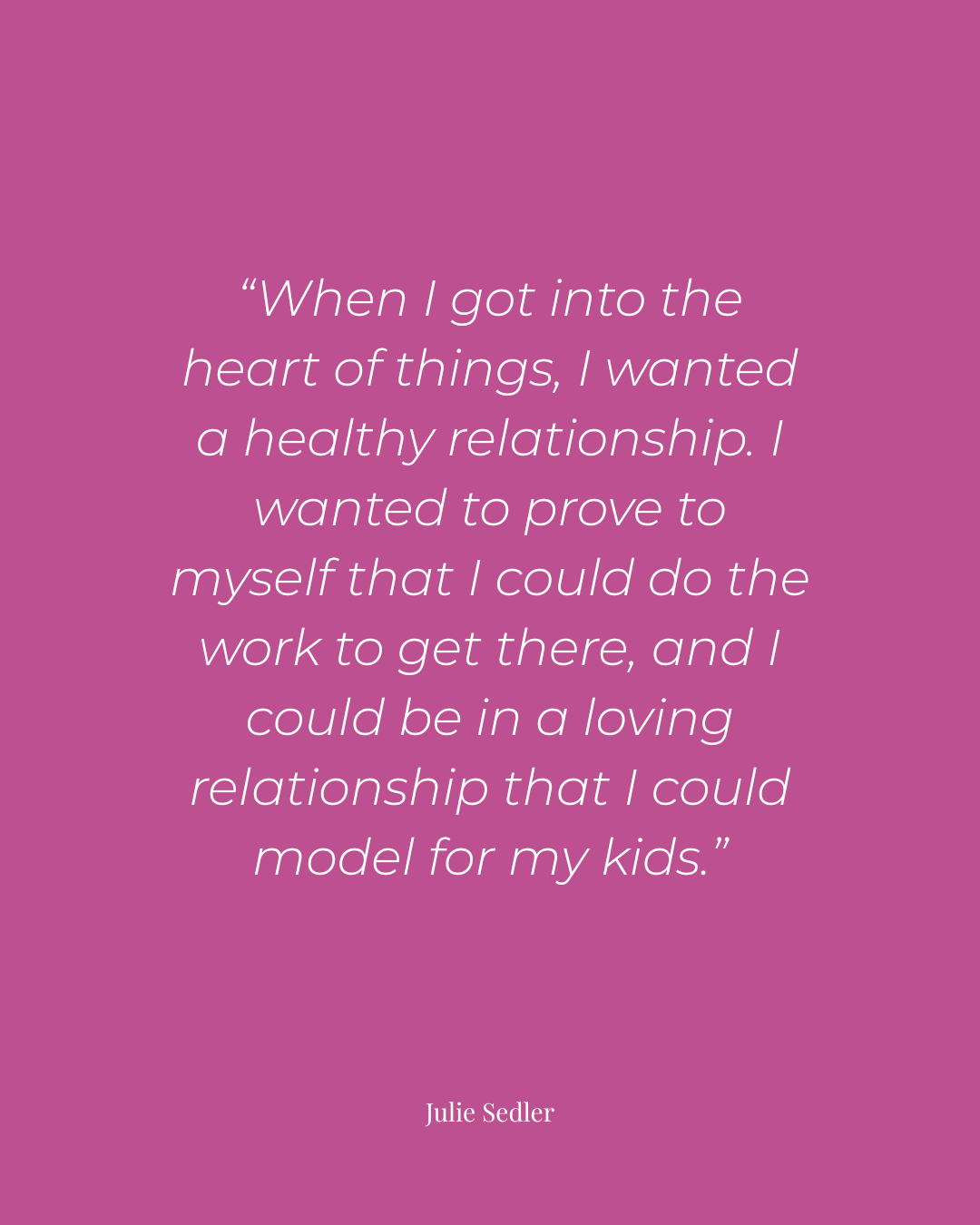
Where I could show them, this is how you have a healthy relationship that honours what you need and also celebrates the love that you can have for someone.
I feel that way for all people, whoever you are. I just want you to be loved, and I want you to be treated well in your relationship.
I want that for you because relationships in and of themselves are inescapable. If it's not romantic, we have platonic, we have career, we have friendships, and then we have family relationships.
Strengthening your relationships is a lifelong skill, and that's what I wanted to work on.
Ultimately, in my book, you see my neuroses of figuring it all out, of my “Oh, shoot, am I going to do the same stuff over again? Am I going to bump up against the same mistakes?” or, “Have I learned the lesson? Am I going to pass this test? Am I levelling up? Or am I having to go back to the beginning of Mario and make my way through the level again?”
Spoiler alert. I do, I graduate, and I get to where I want to go.
But it was one of those things where my book became a how-to manual. I didn’t know how to do this work, I didn't know how to exist in this time and space where Covid was happening, where I couldn’t just go to a bar and meet someone new, or go hang out with my girlfriends or go to the movies. My options were really limited.
So I became very creative in my problem-solving. I had to really understand what the problem was. I had to really get to the heart of, "How do I make things better? What support am I looking for?
That how-to piece, I feel, is missing for a lot of people who are going up against challenges.
My message for anyone that I'm working with is that the process is definable. Together, we can get to the heart of the issue, we can tweak it, we can adjust it, and work on it in iterations to make sure that we finally find something that works for you, not just in business, but in our lives.
On my website, I have a link to join my newsletter list, and I'll send you my personal planning and scheduling system. I've honed this entire routine over the last eight years, and it’s the thing that keeps me sane in the season of life that I am in with raising three kids, navigating a co-parenting relationship, building a healthy relationship with my husband, going to a 9-to-5, owning a business, I'm a writer, and I'm promoting my book. I'm doing a lot.
People say to me, "Aren't you so tired? How do you do all that?”
Well, the fact is, I don't do it all. I do the things that are important to me. I do the things that move the needle based on what's important to me. And then it makes it really easy for me to say no to the other stuff. It could be important, but maybe it's not a priority right now.
I don't get sucked into the, well, the mom group needs you to volunteer. I'm sorry, I don't have time in my schedule for that. But if my kid asked me to be the chaperone on the school field trip, and that's the one way they want me to participate, that I will say yes to.
That I will rearrange my schedule for.
I will say yes to the things that allow me to bond and share an experience with my kids because that's what's important to me.
Having what is important to me clearly defined makes it easier for me to say no to the things that are not in alignment. I think people have a hard time deciding what a yes is and what a no is.
Your attention is a currency. It's a way of energetically budgeting. Where you get to decide, ok, this is how I'm going to spend my precious limited resources and get the most ROI on it, if we want to get into a true business sense.
Katie Eberman: I love how you're mixing in personal priorities, especially in your book, where you talk a lot about self-care and setting boundaries, which was really helpful for me. But then you're also talking about achieving your big dreams and goals. I know that a lot of women are fueled by their dreams to make a real difference in the world, but oftentimes we don't know how to translate them into individual actions and create a flexible and sustainable plan.
Julie Sedler: Something that I would like to add is, you asked about a moment that changed everything, and I have another one that I’d like to share. My mom was a high-profile business person, and growing up, she put her time and energy into her career.
And so when I became a mom, I did a complete 180, where I decided I wanted to put all of my energy into my kids. I found out the hard way, as evidenced here in my book, that maybe I could follow my own goals and dreams in a way that worked for me.
What that looks like is me prioritizing both spending time with my kids and reaching these goals that I have.
When I got the intuitive hit that I was going to write my book, I remember thinking “No, I can't do that”, but no matter what I did, the feeling that I needed to write my book wouldn't go away. It wasn't that I couldn't let go of it. It would not let go of me.
So I decided to write the book, and I'm in the middle of writing my next book.
I'm working with a coach, and in one of the sessions, I'm talking about how I do not want to own my own business.
She says to me, “I'm so confused as to what it is that you think you're doing
here. You are building a business, don't you want people to read your book?”
After that conversation, I had this awakening of, “Oh, I am already doing it.” but I am building it in my own way, in a way that feels good to me, and in a way that honours the things that I want to honour - the amount of time, attention, capacity, resources, all those things that I have to give to make it successful. I feel like I've been doing a decent job of that. I'm still here, I'm figuring it out as I go, just as we all are.
I am able to create my own path with options that my mom didn’t have because of the society expectations and pressures she was making decisions from.
I'm on this mission now where I am taking all of my experience, everything that I know from being in corporate and all of my acumen to support small business owners to create systems that work for their businesses, and I want to make it accessible.
I come in, help you find where you are, define where you want to be and map out the path to get you there.
And I happen to be really good at going from point A to Z, and figuring out all those little stops in between. To me, it's like a really fun game of Tetris or putting together a puzzle.
It allows me to work with awesome people who are doing awesome things who deserve to have the business that they want to have.
There are these really creative people who are out there doing such cool, exciting, interesting things. How can we help them be successful at that?
For me, I became a writer because I wanted to write in my pyjamas. To become a self-published writer, I had to learn graphic design so I could make the cover of my book. It was a checkbox that needed to happen to get me to my goal; these are the little things that a lot of people don’t talk about when it comes to being a creative and building a business.
I did learn that, through the rabbit hole of YouTube videos, apparently we were not supposed to put our picture on the cover of our memoir if we are not, and I quote, “famous”. So now, being petty spaghetti is that I will become famous.
Katie Eberman: Well, sometimes we have to break those rules. That's where we stand out to the people who need us the most. For example I'll have women come up to me, wanting a website and they will say that they’ve looked at other web designers and it doesn’t feel like them, maybe the website feels too cold, or doesn’t have any personality or maybe looks like a template, and I always say, “You are in the right place”, because I want womens voices, and talents to shine through. I want to tell their stories in a way that creates connection and belonging.
In that, though, I am also still learning to feel comfortable in communicating that I'm really good at what I do.
Julie Sedler: Oh, absolutely. I've been in male-dominated fields for my whole career, and I’ve been the only woman at the table. I’ve been the one who everyone is looking to as the leader, answering the questions.
Just think about how long that dynamic has existed and how far we've come.
That's why we're doing what we're doing.
Katie Eberman: Oh, 100%. And even, I think about how we are raising the next generation. I want all my kids to know that they have something to share with the world, and I will support them in whatever that looks like for them.
What’s something you’ve learned along the way that you wish every woman knew, or a mindset, tool, or practice that’s helped you step into your full potential?
I would say, really understanding the phrase “everything in life is figureoutable.”
Because it is figureoutable.
Even the stuff that seems completely unobtainable at first glance.
When you think back in history, and at science, for example, we thought of science as magic. But once it was proven as science, it wasn't magic anymore. It was science. We then accepted it as fact. It's that kind of mindset muscle that helps you achieve the impossible.
It’s in having the mindset of I can figure this out, if I can dream it, I can do it. I can figure out how to get where I want to go.
But then there is this other component that is really the next level of, just because I figured out one way of doing something, doesn't mean that it’s the only way forward.
Sometimes you need to change the way you do things because of the season you're in. Maybe you broke your leg or you just moved to a different city, or you are bringing home a new baby, or your child is starting school.
You get to adapt and figure out a new version that works for you. And maybe it's better, and more supportive.
And that's the kind of next level that I've stepped into.
For example, I am in the season of writing my second book, “Never Say Never: Life is Lived In Between the Black and White,” and I am creating a writing ritual that works in this season of life.
I’ve learned that just because I did something this one way, it doesn't mean that I'm locked into that. I can change it, I can scrap it entirely and find out something new.
Sometimes what you need is someone like me to come in and help you figure it out. To be an extra set of eyes to say, “Have you considered it from this perspective?” Or, “Hey, do you think this would be helpful?” That's part of my offerings.
Katie Eberman: I love it because you can see the big picture, and then you can present different options. I find that a lot of times, small business owners are so overwhelmed with all the decisions that they have to make from day to day.
Julie Sedler: I also want to acknowledge that it is kind of scary to open yourself up and ask for help.
When you are reaching out for help, you need to answer the question, “Do you want to keep doing the same thing and keep bumping up against the wall?” or, “Do I want to face this fear and achieve something better?
For me, I want to go somewhere better. I want to move into something else. I want to move to somewhere better. That's been a big one for me.
What does it look like to work with you?
I find that as a mom building a business, I tend to attract other moms, because we don't have the same 24 hours as people who don't have kids.
I come from this space of knowing what it’s like to do both at the same time, and that's helpful, especially when we're crafting new systems and support, because of the season of life that they're in.
My favourite way people can work with me right now is the Process Pathway Audit.
Where we spend 75-minutes together, and my goal is to help you feel better in your business and life. We start with a brief assessment, and we figure out what you want the focus to be, and I work us through a plan to support you.
After the session, I send back a detailed summary of everything that we talked about, so you don't even need to take any notes, and you're going to receive personalized recommendations. I always include a no-cost, low-cost, and some-cost options.
Depending on the budget, I’m going to suggest maybe starting out with some free tools to use and wait a year to see how that's working. If you find you need more support or want to look into a paid option, we have the option to look at including a higher cost because we've proven the ROI.
I also do one-on-one work with the option to work together over three, six or nine months, and we tailor the experience to you.
One thing I do want to mention is that we're not always going to get it right on the first try. In fact, I posted a reel to Instagram recently where I made a Charlotte. I love being creative in the kitchen and sharing what I’ve made.
I was really intimidated by the Julia Child recipe, but I found a recipe that was super accessible. Where I felt like, “Ok, I could actually try this.”
I tried it, the process was solid, and I made exactly what the recipe told me, but I just didn't like it.
I felt like, after trying the recipe, I could stop thinking about this FOMO from the Charlotte chapter of Mastering the Art of French Cooking, because I don't actually like it.
I'm not saying it's not good. I'm just saying it's not good to me. I would not have known that if I didn't try it in the first place.
Is that not just a beautiful metaphor for being a small business owner?
Sometimes we will do everything absolutely perfectly, and we will get the result that we “wanted,” and we decide that we didn’t like it. We then have the freedom to pivot
For me, I always like to see what skills I can take from what I just did and apply them to something else.
When women read your story, what do you hope they walk away feeling or believing about themselves?
What I want to leave women with is that you can be supported in creating the business of your dreams. The one that is doing what you want it to do, where you feel fulfilled, you are able to scratch that creative itch, and you're making the revenue that you'd like to make.
And the one that feels good. It feels accessible. It feels sustainable.
The legacy I want to leave is being able to see the success of the small business that I worked with five years ago and celebrate all that they’ve achieved, and feel proud that I was able to play a part in their journey.
Katie Eberman: There's something so wonderful about that feeling. Where you get to help someone else and just see them thrive. And I think you really said it well when you said that they feel good and it's sustainable. That's really all that a small business owner wants.
Julie Sedler: They want to feel good when they wake up in the morning.
Here’s how you can connect with Julie: