Experiencing Corporate Burnout to Aligned CEO: Sarah Doyle’s Journey to Redefining Success.
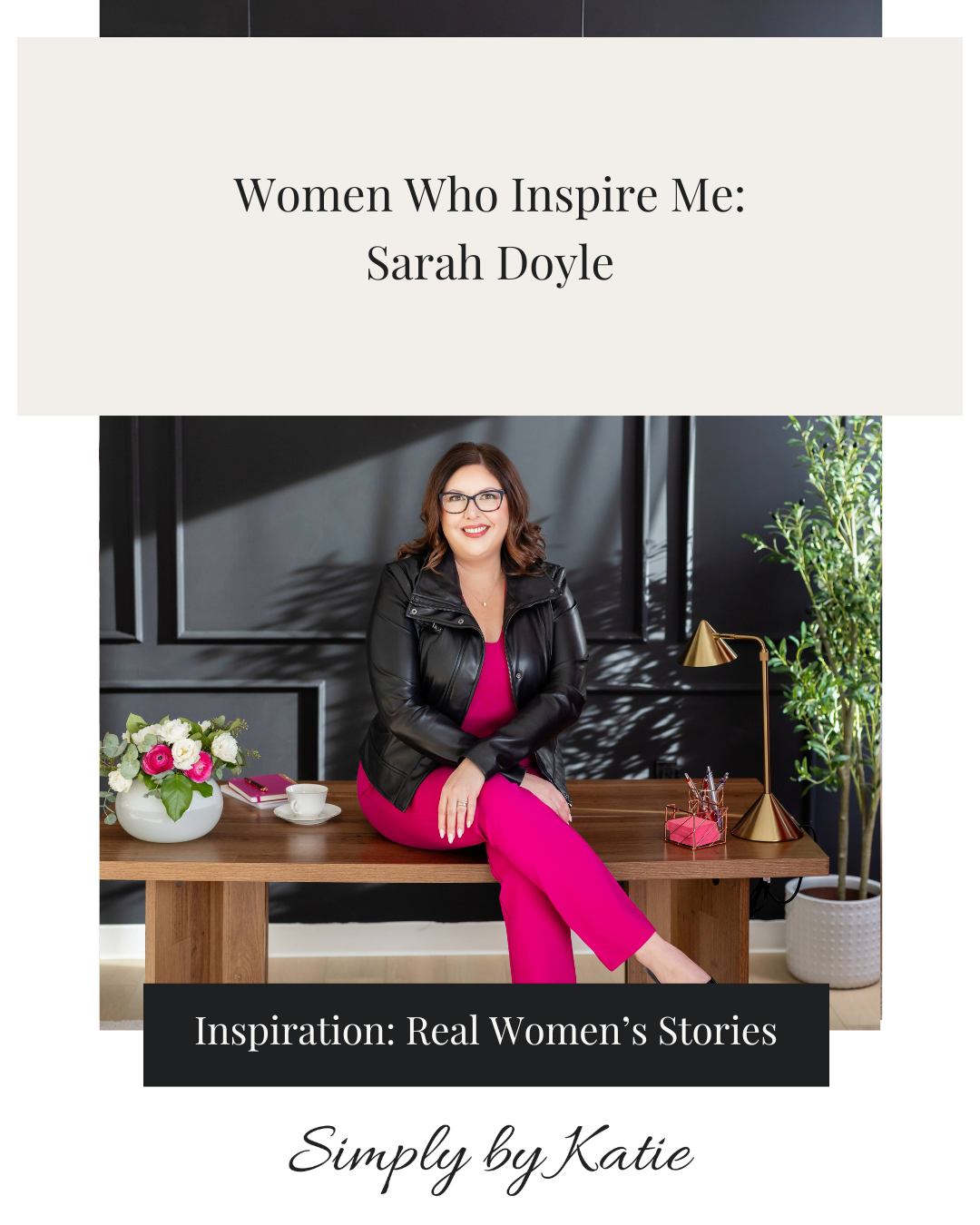
photo credit Christina Louise Photography.
Women Who Inspire Me: Sarah Doyle
For so many of us, the beginning of our careers starts in the corporate world. After investing both the time and money into our education, we excitedly enter the professional workforce, eager to learn and use our newly acquired knowledge. What doesn’t get said or talked about widely is the effect of fitting into long-standing structures that no longer fit today’s world. Where overworking and pushing yourself to the limit is celebrated and encouraged.
What we all know is that women are underrepresented in the workforce, often holding lower-level, low-paying positions. Collectively, we believe that our worth is tied to how productive we are, and this is simply not true. It is widely known that women carry the mental load at home, but so do they in the workplace.
This is exaggerated when we are promoted to mom, and we go to re-enter the workforce. I remember back to the time when I decided to start my business. At the time, I was at home with my two boys, who were almost one and three at the time. I would sit on the floor as they played around me, lost in my thoughts, thinking about how I was to create an income for myself again after being mom for so long. Mom was truly my identity at that time; I had lost who Katie was. I couldn’t imagine leaving my two young boys to go back to work, yet I had this desire for more. See, I loved working; I have always prided myself on being able to take care of myself, and I truly enjoyed being part of a team.
Most days, I would strap the boys into the tandem black and red stroller and walk. There was this beautiful forest near where we were living at the time, and I could walk for hours, listening to the birds and the wind rustling through the leaves, my mind turning over what I was to do next.
It was in those times of solitude that I recognized that I had to create a new path for myself, one that I had no idea of where it would take me. One that I had never seen modelled before me, but I trusted that I would find my way as I took each step forward. Because I quickly recognized that I no longer fit anywhere. I no longer belonged in my previous professional roles as my kids needed me, and although we don’t say it out loud, there is a stigma against working moms. This idea that we are not as serious about our work, or that we are unreliable to hire because we often are the ones to accommodate our kids' schedules and sickness. Even though we feel like we are the most qualified than we’ve ever been. And I was no longer just mom, an identity I was so comfortable in, because I needed to earn a living, and I had this big mission on my heart.
As I talk to more and more women about their experiences in entrepreneurship, I see this very same pattern emerging. There was a point in their journey where they were trying to fit into a system that we weren’t meant for. A place where the female perspective was completely missing. We were expected to act as if we didn’t have kids when at work, and then at home, we became mom again, completely shedding the identity of the working professional we’ve been playing all day, to continue working well into the wee hours of the night. Oftentimes, working on our laptops, with a cup of tea and a TV show on in the background, the dedication is never-ending.
This is where I am honoured to introduce Sarah Doyle. Sarah is the founder of Coach for Success, a leadership development and coaching company on a mission to double the number of women leaders who are breaking through to executive positions. She brings over 24 years of experience working in male-dominated workplaces, and I appreciated her honesty in sharing what it is like to move from the corporate world into entrepreneurship, and the tools that helped change everything for her.
This is Sarah’s Story.
Can you share a bit about your journey, the path that led you to where you are today, and the moment that really changed things for you?
In 2023, I went into entrepreneurship to support the number of women in leadership positions and in entrepreneurship. In the past year, my mission really became clear to me. I had come across a recent statistic that I found very disturbing. This was a global statistic that shared the current number of women leaders versus male leaders in the workplace. What is said is that we have 29% of senior C-suite executives who are women, versus around 71% who are male.
Of that percentage, only 7% of the women are women of colour. Meaning women of colour still have way further to go than women in general. That imbalance plays out in workplaces around the world where we don't have the perspectives and lived experiences of women in the rooms where important decisions are being made.
It's really crucial to me that we start to change that. That we start to change the power dynamic, and we start to have more equitable structures.
The United Nations estimates that at the current rate, it will take 140 years for women to be represented equally in positions of power and leadership in the workplace. This means I won't see gender equality in the workplace in my lifetime, or my daughter's.
You might be asking, "Why does Sarah care so much about this?”
Well, because I spent 24 years of my career working inside male-dominated workplaces. I worked inside the government first, and I found that it's not just politics that is male-dominated, but it is also widespread across leadership roles in the public sector. If we look at the number of women in that sector, there are tons of women, but they hold lower-level jobs.
There's an imbalance in power.
And then I moved into a civilian role supporting the police service. I experienced a definite imbalance there. It was paramilitary, so it was very hierarchical, rigid, structured, and I found that environment was so totally different from anything I'd ever experienced.
Utilities is another male-dominated industry. I worked amongst power and water technicians, engineers and scientists. At the utility company, there was only one woman on the executive team. She didn't have children, and I found that I didn't have anyone to look up to who had a balanced life of managing the home front and managing a leadership career.
After that, I went into banking.
I should mention that my profession was in PR and Communications. I was on the corporate communications team in all of these organizations. I had the perspective of working very closely with the executives. I would write their communications strategy and messaging, but I wasn't one of them.
I look back and remember that I worked 24/7, because I was in an industry that was always “on”, while I was also trying to be an active mom and a wife.
I found that there was a huge conflict in my life because the Sarah who wanted to be the consummate professional, always delivering and performing, who was always proving herself, had to work relentlessly.
But then there was another version of me. The homebody who loved my family more than anything. I wanted to be a good wife, a good mom, and I wanted to be present at parent-teacher interviews and school concerts.
Everything about my life was in conflict when I was working a corporate job.
A couple of times, I left my corporate roles to do consulting. Ultimately, I would find my way back because at the time, there was more opportunity for me in corporate. It felt like it was hard being an entrepreneur because I was doing it all alone.
When I started consulting, business was still conducted in person, and there weren’t as many online tools. To be honest with you, when I first started doing consulting, there was no Zoom. That sounds ridiculous, right? That there was no Zoom?
So much has shifted since. Back then, it wasn't a global marketplace like it is now for consultants. For example, if you lived in Edmonton, you only did business in the Edmonton market.
In my last corporate role at the bank, I was at the top of my career as an Associate Vice President in corporate communications. I had risen through the ranks, and I had been promoted to lead a national team across Canada. My team was responsible for crisis communication during COVID. Daily, I would meet with senior executives who looked to me for all the answers, because I was the one responsible for what we said as an organization. Just imagine the version of Sarah who was being asked, “What are we saying today, Sarah?” in such an uncertain time.
You know how fast it was changing then. From day to day, so much information was coming out, and it was always evolving. For example, advice kept changing from mask on, mask off, mask on, vaccination, no vaccination, vaccination, no vaccination.
It was a crazy time to be leading communications.
In the midst of all that, I was a mom with two little kids who were stuck doing online learning. We were trying to adapt, and I felt like I was failing on the home front. My husband was being taken away to jobs where he wasn't allowed to be at home. I was juggling all the parenting and remote work.
At that time, my job required so much of me that I was working 16-hour days. It was unsustainable for somebody's physical, mental, and emotional health to keep up with. It pushed me to a limit that my body physically collapsed. My body was saying to me, "We actually can't do this anymore, we can't sustain this pressure,” and I felt like a huge failure, because I was thinking to myself, “Oh well, it must be me. I don't have the capacity. I don't have the capability. I'm the problem.” Like that Taylor Swift song: “Hi, I'm the problem. It's me.”
Looking back now, of course, I know it wasn't me. It was a system problem, where so much was expected from one person. We had no extra people on the bench. To be honest with you, I was working in a role where I was so productive that I was working the equivalent of three full-time jobs. I think remote work increased our efficiency and many of us ended up with more than a full-time job.
I know this because when I went on leave, because I had become sick from overwork, the company brought in three people to backfill my role. That was all the evidence I needed that it was time to make a change.
While on leave, I began to see things differently. I recalibrated my nervous system and got out of survival mode. I began eating regular meals, drinking water and exercising again. As the fog lifted and my body healed, I returned to feeling more grounded and present. I reconnected my mind, body and spirit. I got back some semblance of normalcy.
I became intentional about my well-being and created healthy boundaries for the first time. Unfortunately, this was inconvenient to the company that benefited from my sacrifice and productivity. Putting myself ahead of my job was challenging and was met with some resistance.
The pressure of work did not stop. The expectations were as high as before, except I wasn’t willing to make myself sick again. I asked for more staff and I was told, “There’s no budget for that”. In fact, there were budget cuts coming, and my team of 15 was going to shrink down to eight or less. But there was no less work.
In that moment, I knew this job was no longer for me. Mentally, I said, "Nope, I'm out”. A week later, I gave my resignation. Honestly, I didn’t have a plan and I didn't know what I was going to do next. But I was 100% sure I was no longer going to be a workhorse for a company that didn’t value me as a human being.
What I did know was that I had a massive mortgage on a brand new home that I had just custom-built. I knew I had two kids who were in elementary school and junior high, who needed me to support them and I needed to reinvent my career.
So I did. I remember thinking to myself, “This is going to be hard.” I didn’t know what kind of business I should start, who I would serve or what I would offer. But I was committed to making it work because I wasn’t going back to corporate. I said to myself, “We are going to chart a new path for ourselves. We are going to do something totally different from before and create more balance. We are going to look at all of our skills — because we have amazing skills that we've learned — and we're going to figure out what we really love doing the most.”
I think I'm a bit of an idealist at heart, and so I really believed, like I still do now, that you can literally do anything you put your mind to. It all starts with your mindset. You have to develop this unwavering belief that you can do it and be just a touch delusional about manifesting your dreams.
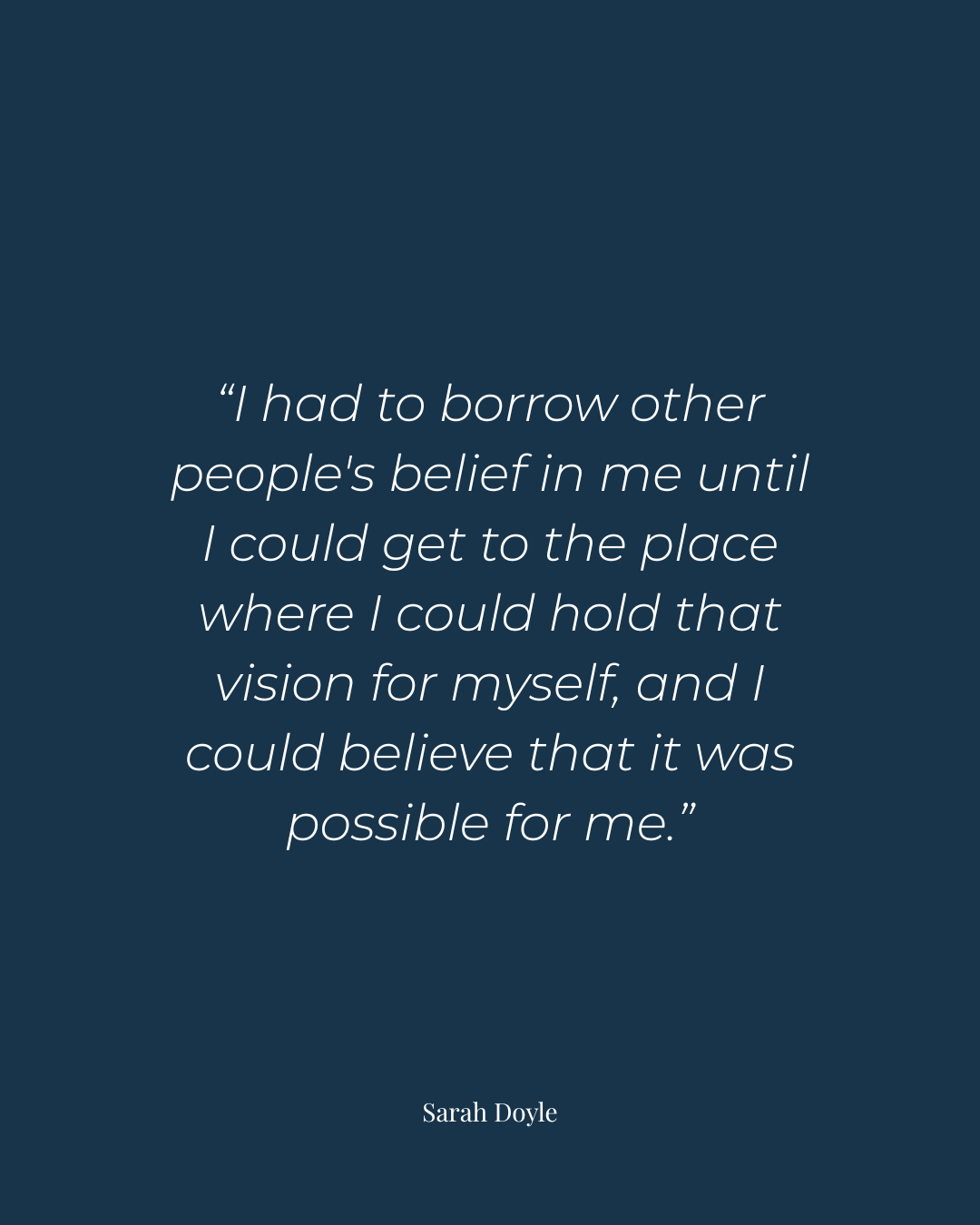
Something powerful that Selina Gray was talking about at Trailblazer was this idea of borrowing other people's beliefs until you believe it yourself, and that’s exactly what I did. I had to borrow other people's belief in me until I could get to the place where I could hold that vision for myself, and I could believe that it was possible for me.
When I started down the path of professional coaching, I thought to myself, I'm just going to finish these certifications and coaching programs and see where it leads. Then it grew into something bigger: I'm going to become an amazing, female coach who is empowering other women who are going through really tremendously difficult times, either in their corporate jobs or in their entrepreneurial journeys, because I’ve done both.
Self-doubt crept in at times. I didn’t know how I was going to find the women I wanted to help, and I thought, I’m not sure that they're actually going to pay me to do this.
When all of those critical thoughts would creep in, I practiced positive self-talk, “Thank you, brain, for showing me all the things that could go wrong. Thank you for catastrophizing all the ways I could fail,” and then I would move on.
I met people along the way who taught me how to shift my thoughts from being in a scarcity mindset to truly believing that there's an abundance of clients, success and money available for me.
I'll give you an example. One of the recurring thoughts I had was, “Well, I'm a leadership coach, and so are a billion other people. Why would someone choose to work with me?”
That was a question I literally couldn't answer for a full year. I’ve worked on the answer to this question since, and I saw that yes, there are a billion people that I'm competing against, but there's only one of me. People will come to work with me because there's only one of me.
That was a huge aha moment for me. It sounds so simple, but it was profound. Combine that thought process with my new abundance mindset of “there's enough for all of us, we're not in competition,” and it paved the way for a mantra that I have, which is “collaboration over competition.”
I think that as women, we have been programmed to compete for jobs, compete for roles, compete for that one seat at the table, because we know that eight out of nine seats are going to men, and there is only one for a woman.
Since that aha moment, my life shifted, my life transformed to now anything's possible, now I can literally do anything that I put my mind to.
Once my mindset was solid, my challenge shifted to I don't have the systems or processes, and I don't know how to do what I need to do.
In response to this, I committed to figuring it out. I watched people already doing it, and I asked the question, “How did they do it?”
I went to so many free courses, clicked on all of those click funnels. You know the ones that promise that they have the one solution to your problem for free? I was always testing different things, with the attitude of trying to figure it out, and borrowing proven strategies that worked for others.
Part of being an entrepreneur is that at this stage, you try, and you fail, and you try, and you fail, and you iterate, and you strategize, you try again, and you throw spaghetti at the wall, and then finally one day, I don't even know what, but something just clicks. All of a sudden, you're like, well, “I'm going to try this one last thing,” and then people respond, you have clients, you're honing your craft, you're honing your skill, you're getting better, you're getting faster, and you're starting to believe in yourself more. That becomes infectious.
Once you hold the belief of possibility for yourself, where you now think: I can do this, I am doing this, guess what happens?
All of the opportunities start to appear. It doesn’t happen all in an instant, you know, this idea of instant success and wealth. But listen, I've been in business three years, and the first year is the hardest. The numbers are staggering for businesses that fail in their first year. It's something like 50% of all businesses fail in their first year.
If you can be in the percentage of businesses that stay open and become profitable, that’s something to truly celebrate.
As entrepreneurs, we forget to stop and celebrate these successes. We get caught up in comparing ourselves against metrics we hear, like I'm not making a million dollars, or I don't have that many people on my email list, or I don't really have that many followers compared to other people.
Think of it this way, I have 200 people on my email list today. Would you think that's a measure of my success? Probably not. But these 200 people have been with me since the beginning. They're engaged.
Building a community, whether that be of clients or an email list, has to start somewhere. There were so many things Selina said that were so powerful. One thing that I remember is this idea that it all starts with one. One person saying yes. That’s how I started, with one person on my list.
I look at what I have built and say to myself, “I have 200 engaged people, that's ok, because I don't need a million followers to be successful.”
I’ve redefined success on my own terms and now I help my clients do the same.
What’s something you’ve learned along the way that you wish every woman knew, or a mindset, tool, or practice that’s helped you step into your full potential?
For a lot of women that I work with, they are coming from this place of being an employee. Where everybody gave them directions, and they are having to develop the mindset of, “I’m the leader now, the decision maker, and how do I now make decisions? How do I be the person who takes the action when somebody's not telling me it's the right decision?”
I work a lot in my business with women who are going through that identity shift, because in order to reach the next level of leadership, you actually have to make a shift inside of yourself. There has to be something neurologically that changes. We need to create new neural pathways.
If you want to go from corporate girly to badass CEO, you can totally do it, but you have to be so committed and so disciplined. You have to want to reach your goal so freaking bad that when it gets hard, you're not giving up.
Especially when it feels like nothing is happening and you’re spinning your wheels. Stick with it, adapt to the challenges that come up for you and become the version of you that succeeds. That's probably been one of the greatest lessons in my three years of building my business. At the beginning of your entrepreneurial journey, the math doesn't math.
What I mean by that is that the amount of effort we put in those first years of business doesn’t always equal the amount of money that we are bringing in. I probably paid myself $8 an hour that first year. That’s ridiculous, right?
What’s going to keep you going through these times is the willingness to put in the work, to try different things, to continue to hold that bigger vision for yourself. Know that you have to go through all of these little lessons to be this version of yourself that you've actually never been before.
I want you to see for a second that you're doing the things that will help you move forward, you're taking chances, you're taking inspired action, and that’s what matters in entrepreneurship.
For both of us, it was an inspired action to step into Trailblazer. Had we not stepped into Trailblazer, we wouldn't be sitting here right now talking.
We had to overcome the initial cost to attend, the unknown of, I don't even know what this event is about, and we had to overcome the fear of rejection. The inner dialogue of, “Am I going to belong in that room? Do I know enough? Am I an entrepreneur? ”
Instead of listening to these fears, we had to choose differently. Instead of seeing women around us who are making $1 million dollars a year and questioning if we belong, we believed in our hearts and followed our intuition that this was the best path forward. It's in listening to these tiny little moments to guide us forward that you and I are now in community. We're in the Trailblazer community. We have affinity and alignment, and we hadn't even talked before today.
This is how the magic starts to happen. We don't have to know all the answers to start to shift our lives. We just have to surround ourselves with the right people. When I stepped into Trailblazer, I felt, "This is a high vibration room.” It was a place where the women in the room could fuel business for every single person in that room, without us looking outside the community.
Imagine the power of that community of 120 women saying, "We're all going to support each other's businesses. We're going to refer from right inside this community because we believe so strongly in each other.”
When you surround yourself with a community of like-minded women who hold the perspective that if you are in the room, you belong, and there is no requirement to prove yourself in these spaces, it's life-changing. You enter a safe space where we all know you’re here for a reason, we all know that you've worked hard to get here, and there’s no proving necessary. This is a completely different world than the corporate environment we came from, where we had to prove we belonged first.
We're all collectively over having to prove ourselves. For me, if you made it this far, if this is what you decided lights you up, if this is the skill that God gave you, why would anyone question that? This is clearly your genius, and if it's not your genius, then I'd encourage you to find the thing that is the seed of your genius. But it’s not for me to doubt your gifts.
This is why I love working with entrepreneurial women. When we choose aligned work that we are passionate about and where we believe that our work is going to help the people around us, it ripples outward. When a woman truly believes that about herself, everyone who encounters her believes it too, and they are inspired to make the necessary changes in their life.
Which is so counter to the way things have been. It's always been, show me the evidence, show me more. We're changing that in how we do business, and I'm certainly changing that in how I run my business.
I recently changed the way I approach my sales process, because for a long time, sales made me cringe. We were taught to lure people in, convince them of a need, show ourselves as the only solution and then apply pressure. This approach makes me and so many other women entrepreneurs, want to vomit.
That way of doing business is not aligned with us. As the leaders and founders of our businesses, we get to choose a different way of doing business.
My sales process now is so simple. In the very first meeting, all I'm doing is getting to know you. That's it. We chat, I ask questions, I don't even talk about my offers or the numbers.
Often, at the end of the call, I’ll have people ask me how we can work together, and only then do I book a second meeting to go more in-depth.
I find that it’s natural that when people first discover us, they want to start by dipping their toe in the pool to see if there's alignment, before they fully commit to working together. And if there is, it’s inevitable. I don’t need to apply pressure.
I’ll share a story with you, one of my clients, we worked together about a year ago. She was a consulting client that I wrote a strategy for on gender-based violence, and we’ve built a work relationship. I messaged her to see if she wanted to meet up after work, and she got back to me, saying, “Sure. Do you want to come to the Sloan concert with me?” And I responded, “Wait a second. Are we in friendland now!?”
When this happens, it feels like you're not even doing business anymore, because you are connecting with people you genuinely admire and would invite into your living room, because you’re building real relationships and connections with them.
When women read your story, what do you hope they walk away feeling or believing about themselves?
There’s an opportunity for women to switch from the masculine energy model of push, push, push, into the feminine energy of flow, alignment and connection. Start by asking where can we find connection? Where do we find alignment? Where do we have a shared vision?
By starting a new connection with the mindset of let’s spend 20 minutes together to first see if we've got a shared connection. After that, it's an easy step to say, “Hey, would it make sense for us to have a second call to see where we can actually work together?” It becomes an easy invitation, an easy yes.
Katie Eberman: There's something so powerful about inviting and getting people’s permission along the way. I really saw that at Trailblazer with Selina. I was in awe of the way she would bring women up on stage to tell their story, and she would start by asking, “May I share this?”
It really shifted the way that I did business and showed up on my own calls with potential clients.
Sarah Doyle: I'll tell you a secret. What you observed was a very strategic way to get “micro yeses”. It’s a technique used in stage talks and presentations to get buy-in from the audience. Unconsciously, every single time you said yes, your brain was becoming more receptive. It’s a great technique to engage the audience and make them feel like they’re full participants.
A lot of people don't realize that our brains need that. We can't have a full-on conversation that is not business-related, then when you get to the end of it, you say, “Would you like to buy from me?” I'd be like, no, that's totally not what we're here to talk about today, Katie. That's out of integrity with this conversation. But if we know going in that we're having a meet and greet, and getting micro yeses along the way, we may end the call with an invitation to further connect on a second call, where I'll bring a recommendation based on what you've talked about today.
This approach means that I haven't said yes to working with you, but I’ve said enough yeses that I'm that much closer, and that much more interested.
The final thing that I want to say is that my number one message to the woman reading this is that we have to do the foundational work first in order to make the shifts that we desire.
We have to release the programming that exists within all of us that is not serving us as entrepreneurial women, and replace it with new models that work with who we are. For instance, adopting an abundance mindset, believing in collaboration over competition, and having an unwavering belief in ourselves. This is an identity-level shift.
This is the energy we need to be in as female leaders and entrepreneurs in order to reach the success we desire. Every single woman deserves this.
Here’s how you can connect with Sarah: