What’s so beautiful about women sitting together and sharing pieces of their lives, especially big milestone moments like building your career, becoming a parent for the first time, the second time, and maybe more, if your family is anything like mine is that we find belonging in each other.
Maybe we don’t all share the exact same memories and moments, but I know for me, there are always similarities in the feelings and drive behind it all. A lot of times, as women entrepreneurs, there is this storyline that we have to build our businesses in the pockets of time we can find in our busy days.
I know that for a lot of women, this leads to burnout, where you are building something unsustainable, but maybe it’s what we’ve been told is the ‘right’ way to do things even if it literally works for no one.
I can say that with such certainty because that was me in the early days and years of my business. I was raising and growing my young family as I had an idea to start and learn all that I could to build a business from passion.
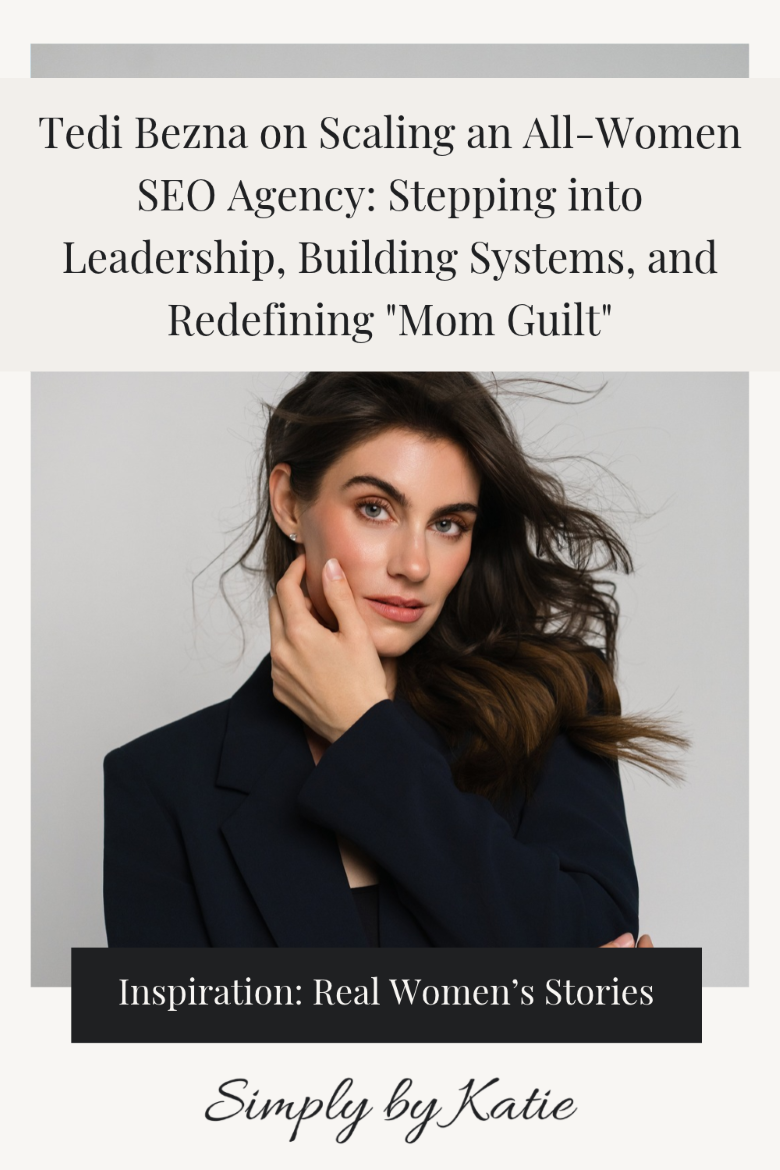
This is where I would like to introduce Tedi Bezna. The CEO and founder of Searchlight Digital, a Canadian digital marketing and search engine optimization (SEO) company. Her team is proudly all-women and all-Canadian.
Tedi shares her journey of transitioning from the corporate world to freelancer to agency owner. The crossroads that led her to becoming a mom, the books that she read as she grew her agency, and her advice for women who want to become the leader and CEO of their team. I promise, you are not going to want to miss this.
This is Tedi’s story.
Women Who Inspire Me: Tedi Bezna
Katie Eberman: Can you share a bit about your journey, the path that led you to where you are today, and the moment that really changed things for you?
Tedi Bezna: The foundation of my story is that I was raised in a very entrepreneurial family.
My dad owned pet stores for over 20 years.
My grandma owned a bookstore.
My grandpa owned a chain of dry cleaners.
My mom had always done entrepreneurial side jobs.
And so from a very young age, I was also entrepreneurial.
I started my first business at 6 years old, making pet grass and wholesaling pet grass containers for the local pet stores.
I sold plums from our backyard on the side of the road.
When we went camping, I would make wasp traps and sell them by the bathrooms.
I just always had sort of an entrepreneurial spirit and a belief that it was something that I could pursue. And it really was a matter of what I wanted to do long term.
My background is in marketing and business. I started my career at a photography startup. And I was working with all of these women who were extremely creative and visual. They were really gifted in that realm, but were not as interested in the data, numbers, and analytics side of things. That just didn't come naturally to them.
Whereas for me, I loved spreadsheets. I was always kind of a nerd with finance and accounting. But I also had a writing background with a journalism edge.
I saw that as an opportunity to really make my mark in this company, where I said, “You know what, I can help to bring these two pieces together.
That ultimately led me to being the digital marketing manager and really pursuing SEO and paid ads. I was doing Meta ads at the time, but being in that environment for about three years, I realized that I wanted to bring this knowledge and the skills that I had gained to a wider range of businesses.
Being raised in a small-business-owning, entrepreneurial family, I knew that those were the types of businesses that really could benefit the most and who, in my opinion, were also the most vulnerable to the bad actors in our space.
Sadly, I think everyone has their story or their experience working with an SEO agency or freelancer who did not perform their services with integrity. You know, everyone's gotten burned. And so it was really important for me to be able to help and support lots of businesses, leading with integrity and transparency and having it be an empowering experience versus something that is scary or a little opaque, where people just don't really understand what's going on.
I wanted to do things differently, and I wanted to grow.
There are two moments that really changed things for me and started these trajectories leading me to where I am today.
Towards the end of my time at the startup, I was starting to feel like a victim of my own decisions in my own life. And I kept on having this recurring thought, which was, “If it was up to me, if it was my decision.” And I never really finished that sentence in my own mind, but I felt like it wasn't up to me, and I wasn't taking ownership and control of my own life.
And I thought, you know, I’m going to learn as much as I can so that I can start to pursue my own thing and start to freelance or start to build something for myself.
That was a real moment where I took ownership and decided to be in control of my next steps. I started to see that I could make this decision, and I'm not at the mercy of other people making decisions for me. I actually get to create my own opportunities here.
And so there's a great picture of me in my bathing suit on the side of the pool reading a Google Ads for Dummies book.
Because in that moment, I decided that I’m taking this week and I'm making a commitment to pursue something and move forward.
Early in the next year, I decided that because startup schedules are very busy, I needed to find a stable job that I could work and build my own freelance practice.
And so it worked out perfectly that I was able to get a job with our provincial government, which had great things like Flex Fridays and predictable schedules. So I could take meetings, and I could leave work at work, and then started building my freelance clientele on the side.
I did that for a couple of years and was able to match my government salary within the first two years of just freelancing.
That sort of came to a bit of a fork in the road where my husband and I wanted to start our family, and it was taking longer than we had expected. At the same time, my freelance business was growing.
I thought, “Ok, should I just do that full time?”
But I was also succeeding and doing really well in my government role.
And so I thought, “Ok, should I just pursue this and go further down that path?”
I sort of put it out to the universe, asking what I should do. And basically, within a month, we found out I was pregnant, I got a promotion at my job, and things with my freelancing all picked up at the same time.
I thought, well, that's not really giving me much clarity.
But of course, this was late 2019, and come early 2020, in my government role I was travelling around and going to trade shows for B.C. timber sales. So obviously that stopped in March.
I was six months pregnant at the time, and because the world shut down, everything switched to online.
Again, my freelance business really took another step forward because everybody needed SEO.
All my agency partners were reaching out. And so that too was another kind of transformation moment where I knew I was going to be having a child, and I wanted to continue and grow my mission in helping businesses with search marketing.
That's when I started building a team, and when I started hiring contractors here and there, someone to help me with writing, someone to help me with keyword research.
Just little bits and pieces at a time.
But that was really the catalyst to start transitioning from a freelance model to an agency that could grow without me necessarily having to do absolutely everything for it to continue to function and for the wheels to continue to turn.
I had my first daughter in July 2020, so kind of in the heat of the pandemic and continued to grow the business from there.
I ended up finding out pretty shortly after that we were having a second child. That was a moment where I decided that I wasn’t going back to the government with an 18-month-old and a 5-month-old.
That's when I knew that I had to really go all in on the agency and building and growing that.
It's been a really incredible journey. We have an all-women and all-Canadian team, which has always been really important to me and creating what I feel is like a micro-economy.
The fact that I am able to provide full-time jobs to people, and that I'm able to help people pay their mortgages. I can remember back to the first time that someone had to use us to have on their mortgage to confirm that they had a job with us was a humbling experience.
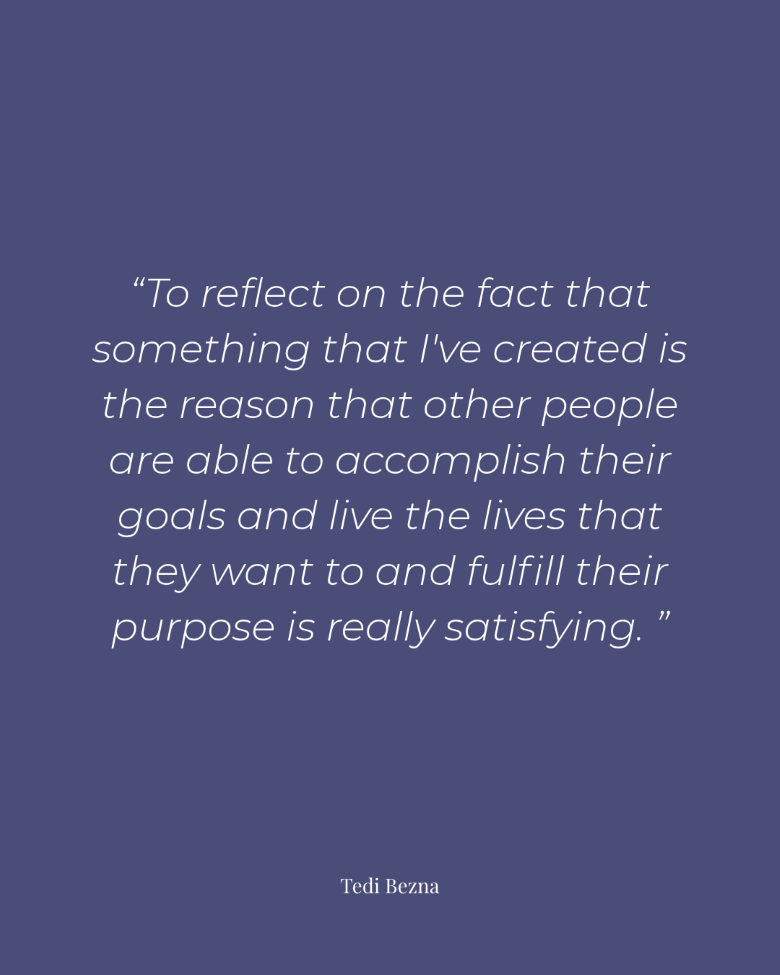
To reflect on the fact that something that I've created is the reason that other people are able to accomplish their goals and live the lives that they want to and fulfill their purpose is really satisfying.
We have grown over the last eight and a half years, but that's how we got here.
Katie Eberman: That is so cool. I appreciate you sharing the different steps of how you got to where you are now. I think it’s important to hear different stories of women who are building alongside a career or while they are raising their family because I think a lot of us, when we're first starting out, we feel like, “Ok, we're not truly an entrepreneur if we're also working at the same time, are we?” We're constantly choosing between the two. And really, I'm learning that's not a thing. To build the mission-driven businesses that we want to build, we have to have that stability piece.
Tedi Bezna: And it was so interesting too because I think if anything, having the full-time job gave me more of a push to pursue entrepreneurship because, especially in the government, it's very hierarchical.
There are bosses and subordinates. It's just kind of the way it is.
And when I would be going to my day job, it's like, well, you're this level, and I'm this level, and I need to review and approve anything you do.
I remember one time, there was an email that I wrote, and it was like an internal email, and it took three months to get approved. And I was thinking, “Oh, my gosh, I'm in these walls, I'm in this box.”
And when I go to a client meeting, when I'm working in my business, I'm the CEO, I'm the boss. I'm the leader. I'm the expert. I'm respected for the work that I'm bringing.
That contrast, I think, also really highlighted in my soul what was ultimately the better fit.
If anything, it was really clarifying versus anchoring to be like, oh, well, this has to be the safety. This has the stability. You can see how people lose their souls working in an environment like that.
You’ll find that it's for some people, and it's not for others. For me, it was really an experience where I could see that there was so much opportunity outside of these walls.
I think it's also a fallacy that jobs are more stable than entrepreneurship, because when you're in a job, your boss can lay you off. Even when I joined the government, the first week I joined, they changed the calculation around people's retirements.
This whole idea of you're safe, you're secure, you're stable, you need this job. In my mind, working for myself, I have so much more agency and autonomy and the ability to actually control the outcome of my life versus having that handed over to someone else, where you never know what's going on behind the scenes. You never know what kind of decisions are being made. You have so much less control over the outcome of your own life when you're working for someone else than when you're working for yourself. So I think that it's something we tell ourselves that maybe isn't 100% true all the time.
Stepping into the CEO Role: Tedi’s Secret to Scaling
Katie Eberman: What’s something you’ve learned along the way that you wish every woman knew, or a mindset, tool, or practice that’s helped you step into your full potential?
Tedi Bezna: The transition from a freelancer who was hiring other freelancers to being the CEO, and having actual employees who are working with me, was a surreal experience.
To be someone's boss was such an interesting mindset shift, because I thought back to when someone else was my boss. On what that felt like and what I needed from that person. Then realizing that I have to be that for someone else was very interesting.
That's been a place that I've been focusing my growth on over the last year, year and a half in particular, because it's not like I went from an entry-level employee, and then to a manager, and then to a boss.
I went from a low-level, let's say, employee to being people's boss. And there wasn’t any training or experience that comes along with that natural transition.
I always encourage people to start small as they go and to think ahead to where you would eventually like your business to be.
It can seem really daunting when you're first starting out or when you're just freelancing, but starting to create systems and infrastructure that would allow you to grow further down the road.
So things like writing down your SOPs and making templates. It's helpful for you, even, because sometimes there will be times when you can get overwhelmed, or there are things that are easy to do when you have one client at a time.
When it starts to become more complicated, for example, when you have four or five or 10, maybe even 20 clients at a time. Having things documented, having CRMs or invoicing systems that are as simple and streamlined as possible will be beneficial when you are ready to bring someone else on at any time in your process.
Whether it remains just you throughout your entire career or whether you do end up bringing other people on, it's really valuable.
I remember often in the early days, I would think to myself, “Oh, well, I'm never going to bring people on in this capacity, so there's no point.”
Down the line, there could be a moment where you want to bring a team member on or hire a contractor, and that’s where you may think that you wish you had the process documented ahead of time.
One of the challenges with hiring and with expanding your team is that oftentimes you'll bring people in and say you don't have SOPs, processes or templates already in place; you kind of assume that everyone does things in the same way that you do it.
Or that the things that are obvious to you will be obvious to other people, and it's not that way oftentimes.
A lot of my false starts in hiring were this experience of bringing people in and handing them the reins without clear instruction or guidelines. Meaning they were set up to fail, and I was set up to be disappointed.
When that would happen, I would think that no one could do it like I could, and so there was no point in hiring.
But I know now that I had missed proper training, proper onboarding. And once I made sure that my expectations were clear, that the deliverables were clear, stating the obvious, even if I thought it was obvious that I stated it anyways.
That change allowed me to have more successful growth rather than being disappointed or feeling like no one can do it like you can.
The greatest thing that I've learned is that entrepreneurship and growing a business, in particular, is like being on the monkey bars of life where you're holding on really tightly to something and then you feel like you can't let go, but you sort of have to let go to be able to reach the next level.
And then you think, “Ok, well, I'm as far as I can go. I can't, I can't possibly let go”.
Then you do.
It's a series of white-knuckling and letting go and holding on tight and letting go.
I think making sure that mentally you can handle that is ultimately the only thing that you can do to grow. If we think of any of the large companies, the person at the top is not the one who is doing the thing.
I will sometimes compare it to a pizza shop. The person who's answering the phone and manning the till is not the person who is making the pizza and delivering it. You can't have one person doing that, or else either the business won't function, or the customers aren't going to be happy; it's going to take forever. It's going to cause issues.
When you look at it from that perspective of how do we make sure that this is an amazing customer experience, setting aside your own ego of everything has to be me, how do we ultimately make this amazing for our clients?
Oftentimes, that is bringing in people where each aspect of that role is their joy and is their area of expertise and the thing that they love the most; that's going to be what allows you ultimately to grow and build a team that delivers on your mission and your vision that you had initially set for yourself.
Katie Eberman: I love all of your advice because I can think of so many women entrepreneurs who feel like they have to do everything in their business in order for it to be successful. I also have had conversations with women who are dreaming of who their first hire will be. I have been saying that I would love to hire a developer to help me with the actual building of my website.
I know that it can feel overwhelming to bring on someone, especially for the first time. Do you have any advice around where to start?
Tedi Bezna: I usually recommend people start with admin support. For example, if your inbox is overwhelming you and you're not getting back to clients fast enough, admin support is the perfect place to start.
For me, it was writers. For you, a developer, where you're still in charge of the strategy, you're still managing everything, things will go through you, but you're getting help with some of the lift.
Some of the scarier parts are when we're handing off client communication.
I was with another agency owner recently who was going through that transition where they are not able to stay on top of everything and needed help.
I think we fall into this belief, which is not totally unfounded, that people are working with us or that they chose us for us specifically. And yes, in some cases, you do build a relationship with a person, and they want to work with you.
But ultimately, and this is kind of that growth pivot, people are paying for outcomes and experience.
If you can still provide them with an amazing experience and an outcome or a deliverable that they love, people don't care all that much about how it gets done behind the scenes.
In your example, say you are able to bring on a developer who's able to quickly and efficiently bring your vision to life; that's amazing.
If you have a client account manager who is really responsive, super organized and great at email communication. That is an amazing customer experience, and they're going to be happy. So I think, again, it's a little bit of an ego death of it doesn't have to be me. If I bring together a team that I have vetted and who meet my standards, then that's an extension and a reflection of me.
Must-Read Books for Women Stepping into Leadership
Tedi Bezna: The first book that I always recommend to people is Buy Back Your Time by Dan Martell. That was one of the foundational books that I read when I started to build a team.
There's another book called Work Less, Earn More by Karl Sakas. That's a really great book for growing an agency in particular, and it has similar themes to Dan Martell's book.
Those are two of the big ones that I think really kind of transition things for me.
There are a couple other books I would recommend. There's one called CEO Excellence. That's more about being a professional CEO and includes insights from conversations with some of the top CEO’s. It goes into topics like how to make decisions, how to analyze opportunity costs, and things like that. So it's a little bit next level, but there are a lot of nuggets to take away.
And then The CEO Next Door, that speaks to building a leadership mindset.
How to start documenting your processes
Tedi Bezna: I would say start by just writing out your process, both on the back-end side as well as the client-facing side. Be as specific and granular as you can get.
An example that comes to mind is an email that goes out to a client.
Write out the standard process from the client side, and then the process for the internal side of things.
My favourite tool to use is Loom. Especially if you have the paid version, you can record yourself as you walk through it on your computer.
There is also an AI integration that will turn that recording into an SOP for you. You can literally copy and paste that SOP into your document.
We take it one step further, and we use Asana for our project management with templates created for all of our different project types.
In Asana, we will have the name of the task, the step, the estimated amount of time that task should take, and a link to that Loom to walk through.
It will also have either a copy and paste of the SOP or a link to the SOP if it's a lot larger, but breaking it down into those smaller pieces, where it might feel really granular, but things get missed the more vague you are.
So it's really important to break that down little bit by little bit.
And then making sure that is easily available because I feel like SOPs go to die in Google Drive. Nobody looks at it again after it is created.
Having it actually linked in your project management system associated with each task will make it so easy to onboard someone because literally you just assign it to them.
All they have to do is watch the Loom, read the instructions, and complete one small task at a time. Now all of a sudden, they have all the information they need. They can ask questions. But breaking it down like that makes it really simple.
The next thing I would do is to create templates. Email templates, project management templates.
At the very beginning of this process, I initially thought that every project was completely different and unique. And I learnt along the way that there are commonalities.
Even if clients have different website platforms, there is always one universal step to get started.
Releasing Society’s Expectations: Why Your Ambition Doesn't Have to Shrink for Motherhood
Katie Eberman: When women read your story, what do you hope they walk away feeling or believing about themselves?
Tedi Bezna: My message to people, especially as a mom and a wife, is that your dreams are also worth pursuing. And I think that there is a narrative around moms and entrepreneurship that it can only be done if it can fit around your family's life, only if you can squeeze it in during nap time, only so long that it doesn't disrupt the family, then you're allowed to pursue entrepreneurship.
I remember when I first gave my notice at the government, and I said that I was pursuing my business and not coming back. The manager wrote back to me and said, “Oh, it's so great that you're able to have one person earning an income while you work on your little side project. Like, that's really great.”
I so desperately wanted to write back saying how excited my husband is to stay home with our children while I earn the income.
There's always this assumption that if you're a woman and a mom who's pursuing entrepreneurship, that you are working on some little side hustle or that you are just by default a freelancer who's picking up things here and there.
And then I'll tell people, “No, we're actually an agency, and I have a team of 12 people.”
It’s interesting because people, especially at the beginning, were really surprised at the scale of what I was running because they just assumed that because I had two little children, very close together, that I was not running a business at the scale I am.
I was really, really fortunate that our whole family really stepped up to help and support. I always joke around that my mom was there with the catcher's mitt. She would say to me, “Hand me the baby, and go work on your business.”
To say that my husband is supportive of my business is the understatement of a lifetime.
My career and my values are equally, if not more kind of important than his career aspirations. And I think it's just so easy for people to say, “Oh, well, I have to keep it small to be able to fit around my family.”
And I challenge people instead to think: what are the functions that need to occur within the home or within our family, and how can we look at resourcing that in the same way that we do in a business?
One example is that childcare has been huge in my household. When my kids were 18 months old, they went into daycare, and then off to school.
Another thing we looked at was cleaning the house.
I had to decide if it was better for me to spend what would probably be 10 hours a week cleaning the house on my skill set, or hiring cleaning support to come in and make sure that's done.
You know, not everyone needs a personal chef, but can you get some of those, like pre-made fresh meals at Costco or do HelloFresh or something to take that mental weight off of you?
And I think my soapbox and my TED Talk that I will always stand on is that I don't think women's salaries alone should have to justify childcare or should have to justify family support.
I hate when people say, “Oh, well, I only make, you know, $2,000 a month and daycare is 1500. So it's like, I only make $500.”
It's like, ok, well, what does your husband or your partner make? Because your spouse has the ability to work as well, and you are now losing the opportunity cost of your own life.
Being out of the workforce for extended periods of time is a huge risk for women. And I think, especially if you have something for yourself that you're growing and you're pursuing, and you're passionate about, it is a great disservice to your own life not to pursue that just because you have kids.
So I think that it's really important from, again, an autonomy, a security, and just like a life fulfillment perspective to prioritize your own career and growth and your aspirations and your ambitions.
That is an important and incredibly valuable thing to do.
Katie Eberman: I couldn't agree more because I was a stay-at-home mom for a while, and when I started my business, it really felt like I was squeezing my own passion into pockets of my day. That totally shifted when my kids went into care. It's been an invaluable investment in myself, honestly.
I was recently on a podcast, and I wanted to reframe for women what they think child care means. Whether it’s bad, or they don’t want to pay someone else to raise their kids or whatever the narrative might be, because I said the same thing for a long time.
In my own experience, it’s been a way for me to get support where I’m happier, and my kids are happier. It's that we're getting support so that we can go after our dreams without doing it all. I realized that it didn’t mean I was less of a mom because it has nothing to do with my capacity as a mom. And everything to do with having the support that I need.
Tedi Bezna: I think one of the greatest gifts I've given to myself is the release of society's expectations. There is this widespread idea that to be a good mom, you have to be with your kids all the time. Or to be a good entrepreneur, you have to be working 24/7.
You know what? No.
I'm going to do the thing that works for me and my family and my kids and not even to entertain judgment from others.
I am going to do my own thing over here with fulfilled, happy children who are being raised by a village of incredible people who are loving what they are doing. They're doing crafts; they're doing activities with my kids.
If I were home alone with my kids for eight hours, that's not what we would be doing. So they are living in their zone of genius so I can live in mine. Everyone's happy.
Here’s how you can connect with Tedi: