Kerri Affronti on Overcoming Chronic Pain, Nervous System Regulation & Aging Gracefully

Women Who Inspire Me: Kerri Affronti
This was a live-recorded interview on YouTube that we did back in April 2026. You can watch the video recording here.
I met Kerri back in 2024. We first connected because she was looking to collaborate with a web designer to help with her website launch. It was an exciting time because she was getting ready to launch her Years Younger membership, and it was just friendship at first meeting.
We have always had this great connection and could talk to each other for hours. Kerri has also supported me with gentle exercises that I can do away from my screen. I remember telling her about how sore my shoulders and back would get, and she invited me to come try her membership, and I am so glad she did because these truly are the best kind of connections.
What I loved about her membership was that it was easy to follow along. I could close my laptop for an hour and follow along from my living room. I realized that I was just pushing my body to sit for hours, and then I would feel so sore in the evenings and on weekends.
Here is where I will introduce the amazing Kerri Affronti and let you sit in on our conversation.
This is Kerri’s story.
Bringing 20 Years of Pain Relief and Movement Coaching Online
Katie Eberman: I've been working on sharing different women's stories who really inspire me and who are doing something different in the world and creating a different path for themselves.
Kerri and I have known each other for I think it's been two years now, which seems crazy. As I was searching for and inviting women to come share their story, Kerri popped into my mind because her work has been so impactful for me. I really like that she offers something unique, and I wanted more people to hear about what she does and just a little bit about her life story.
I know we were just talking about this, but we kind of connected on Instagram, right?
Kerri Affronti: Yes, Katie is my website designer, and her business is Simply by Katie. She is fantastic to work with. It is so easy to work with you. You are so efficient. I found that decisions are so much easier to make based on what we want it to look like, what the feel is and how we want to communicate our message.
I wanted a Squarespace website because it was integrating with my scheduling software. That happened during the pandemic when I changed all my scheduling software and went mostly online with my work.
I was Googling Squarespace website designers, and I wasn't coming up with anything. I had reached out to a bunch of different people, and it wasn't the right fit, and I just didn't completely resonate.
So then I was like, “Well, why don't I get on Instagram and just try to search for a designer that way?” I think I put in the hashtag Squarespace web designer, and Katie's profile came up.
I looked at your design work, and I was like, yes, this is exactly a fit! You were so professional and just immediately replied. We got on a Zoom call, and we connected.
Katie and I have very different life stories, but we have a lot of overlapping emotional intuition. So when something feels right, we were both like, yeah, let's do this and let's do that. And so it was an immediate intuitive connection. And so, we scheduled something, started working together, and voila, we have a beautiful website.
Recently we did a redesign, and it was, it was a lot more work than Katie probably thought it was. So, so good though, to be able to have like a year in between designs and then go back and look at it and say, well, this worked really well, this didn't work well.
There's been a lot of change because of AI. So we've had a few different considerations to look at with some of the things we were looking at, but the whole process was very fluid and easy. I highly recommend Katie's work.
Katie Eberman: As you were talking, the first thing I was thinking is you're so right. I remember that call when we met. I remember thinking, “Yes, I want to help her!”
I just had that connection with you, right off the bat. We've maintained that connection throughout the years, which I love.
It was definitely this last website update that we did where I was reading through all of the new copy that you had, and I was l learning about what you do in more depth.
Then you invited me to be part of the membership, and I was really excited because I sit such long hours and I'm staring at my computer. Often I'm like hunched over, typing for hours and hours.
But I just remember feeling more free in my body, like just the movements that you were teaching me. I've never moved my body that way.
Every time I work with you, especially when we did this last session together, I had this realization of, “Wow, I don't move my body enough, or I don't honour the way my body needs to move.” I'll just sit and be in one position all day, and I'll go for a walk or something, or I'll do yoga, but my body needs more movement throughout the day.
I think it's important now, in my mid-thirties, to learn to take care of my body so that I age with awareness.
Seeing my own grandparents as they've aged, they tell me that it sucks getting older. They are at a point where they can't move their arms over their heads, for example, or they have to be careful as they walk, or have help as they interact with the environment around them.
It really made me think, “How do I support my body so that I can age gracefully?”
I think a lot of us are thinking about that now. Asking, “How do we support our body so that we don't have to be in pain or we don't have to experience severe mobility issues.
From Early Health Crises to Understanding How the Body Heals
Katie Eberman: In your own health journey, how did your own experience with navigating health challenges shape the work that you do today?
Kerri Affronti: What led me to start teaching is that I've had my share of breakdowns in my body really early in my life and in my career. I had navigated several health crises early in my 30s, really, from 30 to about 40 years old. An entire decade of my life.
I got them earlier than a lot of people, but I also learnt what happens in the body when you set it up the correct way.
Meaning you set up your body for better health as you age. Instead of ignoring it, like we tend to do when we're younger because we wake up and the body just works and we don't think about it.
Then all of a sudden, one day something happens and it's unexpected. And we're like, “Wait, why isn't my body working anymore?”
It's like the engine just suddenly breaks down, even though we had signs telling us that an injury or something similar was going to happen.
Initially, most people I work with, whether we work 1:1 or in my membership, are experiencing pain that is impacting their quality of life.
They are at a stage where they are either suffering, or they are looking to get stronger, looking to get more flexible, more fit, and to learn to exercise in a different way than they have before.
Maybe what they have done in the past gives them strength, but it doesn't help with their mobility, or vice versa, and they haven’t been able to find something that works for them.
Oftentimes, they have a curiosity to improve their health and to relearn how to move their bodies so that it supports their overall health and well-being.
I find that it's less about getting past the pain because once you get out of pain, that's fantastic, but are you going to go back to the same habits that you had before?
Yes, most likely you are, because they're habits. They're deeply ingrained in our neurological wiring.
When we have lost trust in our body because of an injury or chronic pain, say from sitting for hours, it's difficult to start trusting it again.
That’s when we want to learn how to live in our bodies again, and learn to support our bodies' needs as we age.
I have firsthand experience with exactly this process. I had to walk myself through how to trust my body again, to operate out in the world and to really be alive again.
Move Your Spine First, Limbs Second: The Core Principle of Mindful Movement
Katie Eberman: I know you've been doing this for 20 years, and I know you're really good at it because I've experienced it firsthand and I've seen like the testimonials of the people that you work with.
You make real change in their body for them. What advice do you have for women my age, in their 30s or older, looking to start to support our bodies earlier so that we can prevent chronic pain and injury as we continue to age?
Kerri Affronti: I've always been looking at people's bodies and how they move. That has been fascinating since I was very young. One of the things that happens when we're in grade school is we're hunched, and you're in a small desk.
A lot of us will have our hands resting on the desk and our spines curled forward. As kids, we have boundless energy. So we're kicking our feet, maybe we’re kicking the person in front of us, or maybe we're just swinging our legs, and we're not moving our spines at all.
We're just in this confined place, sitting, listening to the teacher for many hours a day. Our bodies weren't meant to sit for those long hours, especially as we were growing.
As you're growing, you're supposed to be running around and playing outside. You're supposed to be getting all the way down on the ground, picking up rocks, picking up things, exploring the ground, standing up, darting across the room with all your energy.
Your spine is getting so many, what I call, changing levels. It's constantly changing levels. But because of our schooling system as the way it is currently, we are having all the energy coming into our legs and sometimes our arms, but not our spine.
What I've learned about anatomy and physiology is that we're supposed to move our body's spine first, limbs second.
And so this is the primary principle of what I teach when I'm working with people.
That can take a series of appointments. Depending on how ingrained their movement patterns are.
I can confidently say that there is not a single person that I have ever worked with who hasn't been able to learn it because it's the way that our neurology is dictated.
How it works is, we have a nerve root, and then we have branches from that nerve root. So if you think of the trunk of a tree, if you feed that trunk and those roots, the branches are going to grow.
So you're consistently feeding that information into the centre point of the body.
That information then spreads through that network, to help inform the movement of the limbs, secondly, instead of the other way around. So it's really reversing the way that we move.
That's the primary thing that I would say to people who are in their 30s who are trying to prevent injury or compression inside of their limbs and joints is to learn how to move your spine first and your limbs second. Because what happens if you're only moving your legs while you're doing Peloton or you're doing a spin class, you're not moving your spine and missing a crucial step.
Katie Eberman: Thank you for sharing that, because before working with you, I had no idea that there was another way for me to support my body and to encourage movements that would help me not just now but to build resilience in my body moving forward.
Was there a moment in your life that really changed how you approached exercise?
Kerri Affronti: I was fascinated by pain very young. At around 10 years old, I had my first dance injury.
I fell, and I hit my tailbone really hard on the ground. I was in so much pain, and I was so young.
I was being homeschooled while I was healing, and I had a lot of time to think about pain and where pain is. When do I feel it and when do I not feel it, and where does it go? Does it go away? Why does it come back?
I have always been really curious about how we alleviate pain and the processes we go through to alleviate pain.
Many people will alleviate pain, as a first line of defence, with just anything that will take them out of pain. And that is necessary in order for us to create some space between our receptors of pain and the ability to observe what's happening to ourselves so that we can make some informed decisions about what to do next.
That's why the medical system exists, right? And it's appropriate, and some people will go right into surgery.
Some people will go into medication.
Some people will go into wanting to get a diagnosis.
And that can be incredibly effective when someone is at a lower level of stage of healing, of a consciousness of healing is in stage one.
What I would consider extreme suffering.
As you move through consciousness and different levels of consciousness, there are different remedies.
As you move up sort of this step ladder of increasing your awareness of the many aspects of your life that are contributing to the pain, that's when you can start looking at, ok, what has been working for me in the past? You're making associations, and what might I do in the future?
When you go on that search and you start to try to figure out what's going on for you. That's when you can acquire a teacher, a mentor. You get new information, and you might end up talking to someone else who has also gone through what you've gone through and who has also suffered in the same way.
That's where we start magnetizing the information that we need that will start to allow us to begin that healing journey and go to the next ladder for ourselves.
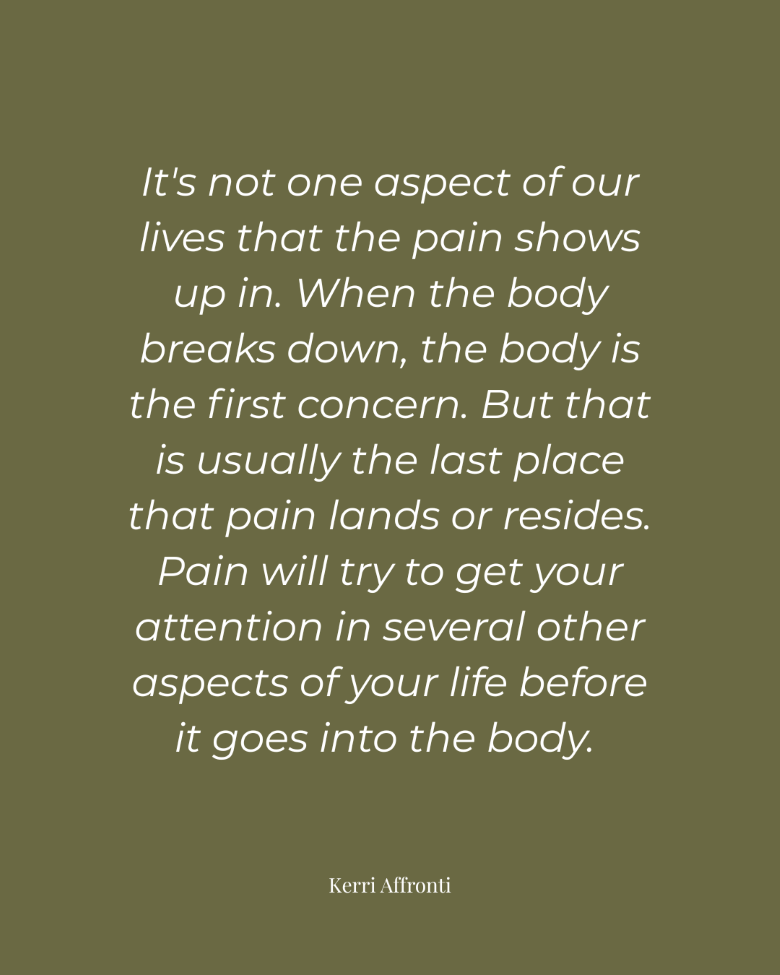
As I found my magic genies when I was younger and found my mentors and the people who taught me about how my body worked and how the body in general works, and how I've talked to you about domains of concern. It's not one aspect of our lives that the pain shows up in.
As we all know, stress contributes to pain. There are several different areas that you can experience stressors. When the body breaks down, the body is the first concern.
But that is usually the last place that pain lands or resides. Pain will try to get your attention in several other aspects of your life before it goes into the body. But once it's gone into the body, then you've got to work your way back out of it.
Unprocessed Pain, Stress, and the Emotional Connection to Movement
Katie Eberman: In your experience and from your own years of learning about movement and the body, how does emotional pain or stress manifest itself in the body?
Kerri Affronti: If you start to observe your body and listen to its subtle signals about the information you're receiving, you already know where you're compensating.
You already know where you're stressed.
You already know the relationships that are causing concern in your body.
Your body will create congestion when you're not able to process a thought or feeling.
Your body will land you on your butt so that you start paying attention to other aspects of your life so that you can start working on how to work through those.
The magical part is that you can work through those in your body and that will ripple out into other areas of your life.
Katie Eberman: I've always understood the saying about how everything is connected, but not so far as to bring it back to, there's something else happening in my body that's unprocessed. In hearing you explain your experience and background in pain, I had a lightbulb moment. There's something about the movement piece that helps you process and release things that you can be holding onto.
Whenever I've done your classes, I've always been so surprised at how much work it was. When you told me it was seated, I didn’t know what to expect, and I was surprised at how focusing on moving my spine and my core was a hard thing to do.
It made me think about why I am not using my core muscles more in my day-to-day life, even with something simple like walking.
I even think of watching my grandparents walk and seeing the way that they move. How they are mainly shuffling their arms and legs along, and I do it too. It’s just more pronounced as we age.
I think that the work that you do is so important for all ages, because you teach people how to connect back to their bodies.
Something that I experience as a working mom to three young kids is that stress and tension show up in my jaw. I’ll find myself clenching my teeth together, and my shoulders will be up really high.
When I’m in that overwhelmed state, something small, like the kids asking me a question, can have me yelling unexpectedly. I’ve realized that when I’m stressed like that, I need to take a minute to take some deep breaths to regulate myself.
I know from working with you that breathwork is so important for the health of your nervous system.
Kerri Affronti: I feel like I could do breathwork every single day and it would still never get boring. I was telling you before we started the live that I went hiking yesterday, and my nervous system was so happy because there was no sound.
In my home, I have several pieces of equipment that help me to do the work that I do, and they have magnetic frequencies. That slow humming of the refrigerator or that humming of my computer in the background is happening all around me throughout my day.
When I was out on the hike, the noise wasn't there and my nervous system just totally stilled.
In our daily lives, whether we're commuting, we're stuck in traffic, or we're behind computers, we hear a lot of background noise. Our nervous systems don’t ever get a chance to reset.
Learning to practice breathwork is a vital component of healing your nervous system and of the entire process of how your body heals.
I teach people to understand their body in a comprehensive way, starting with breathing, then introducing how to move your spine.
What's really important is that if you approach an injury, a disease you're diagnosed with or something that's going on that's very serious for you with a repeatable strategy, you can build a better understanding of your body.
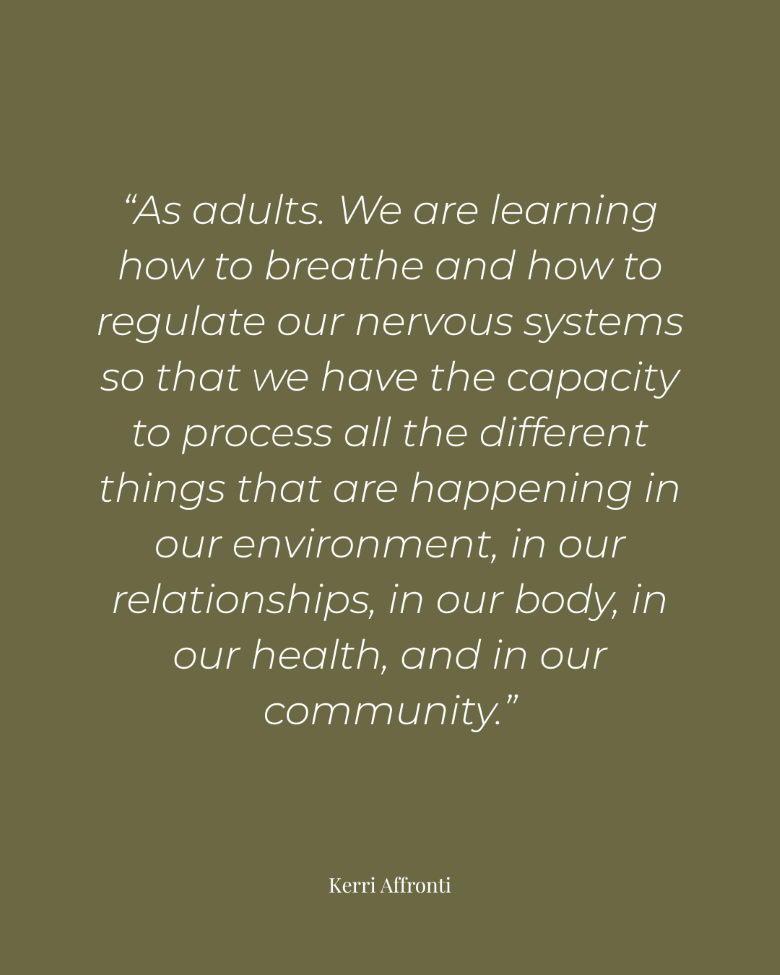
We didn't get the opportunity to learn these tools as young kids and are now learning them as adults. We are learning how to breathe and how to regulate our nervous systems so that we have the capacity to process all the different things that are happening in our environment, in our relationships, in our body, in our health, and in our community. In all aspects of life.
Then we're going to learn how to move our spine first, limbs second.
We're going to start to move from our core, and we're going to start to connect with our abdominal region, the center of gravity in your body.
Then we're going to learn how to balance from that centre of gravity in your body.
And then we're going to learn how to build strength around that balance.
In my membership, I’ve taken my years of understanding how the body heals pain and broken it down in a way where one component builds upon the next for the best results in our bodies.
Box Breathing: A 5-Minute Practice to Calm Your Nervous System Anywhere
Katie Eberman: What is one practice you can share that people can do from home, in their cars, to help regulate their nervous systems?
Kerri Affronti: One of the things that I like to teach is something very common, called box breathing. It's so simple. All you're doing is you're breathing in at the count of one, two, three, four.
You are holding your breath for four counts. One, two, three, four.
Then you're exhaling for four counts. One, two, three, four.
Hold your breath again. One, two, three, four.
So you're making a box with your breath.
It's a very simple five-minute exercise that you can do and just count in your head. You don't have to count on your fingers, and it will really assist you in calming your nervous system immediately and refocusing on the task without having to get up, get water, get coffee, or take a break.
You can just reset yourself with your breath.
When you start to breathe, you can start to get curious with the process and ask yourself, are you breathing from your diaphragm? Are you breathing from your chest? Are you breathing from below the navel? Can you breathe through all three of these centers?
All three of these centers, are they syncing up and intelligently informing each other in a rhythm? Or are they kind of erratic?
Are you focused, you know, more on breathing in this one area, and this other area is restricted? And working with that in just in itself can be really powerful. You can have some very nice unwinding experiences for your nervous system.
Animals do this inherently. If they get injured, they will all of a sudden start shaking. Their nervous system will process that injury through a rhythm, through a shaking, through some sort of vibrational movement. After they process that injury, they go back to hunting and gathering, et cetera.
We don't do that. We don't stop.
So this is something we can do consistently and continuously to process old trauma and to process the everyday experiences that are causing our hormones to go out of control.
We're not made to sit at desks, and we're not made to have all this information flooding into our brains every day.
We are made to be much more still and reflective.
I like to teach this technique because I want to give people a tool where they see a quick result, that allows them to self-regulate without anything other than their breath, something we all always have.
When we are able to self-regulate, we don’t necessarily need to self-express what is happening for us internally, but we can calm our nervous system down enough so that we can work through the stress, pain, et cetera in a more authentic and calm state.
When you start small, with breathing and with spinal movement, you start to inform your body that it's safe again to be trusted.
I was diagnosed with an autoimmune disease where I experience a lot of inflammation.
What I’ve learnt about inflammation is it can happen in the joints, it can happen in the skin, in can happen in all areas of our body.
When we calm our nervous systems using breathwork, it's really amazing how that affects the other systems in our body, not just our nervous system, but it's going to affect the immune system, it's going to affect your cardiovascular system.
You are going to increase your capacity to start healing other aspects of your body just by learning how to breathe.
Katie Eberman: Are there any other tools that you recommend that are effective to deepen our healing practice?
Many people use vibration guns that they're putting on different tight areas of their body to relax and to release tension. Or vibration plates are very powerful as well.
Rhythm is another extremely powerful tool.
That's why healing with walking or healing with music can be so effective.
We can be sad when we're listening to music, or we could be really happy when we're listening to music, and we start to tap into another part of ourselves that has more emotional availability, joy and freedom.
The same with walking. When we're walking, we're walking rhythmically.
So when you learn to move rhythmically, even if you feel like you have two left feet and you can't move rhythmically, you can.
We all have rhythm. Our hearts have rhythm. Our breath has rhythm.
You have three different rhythms in your body that you can tap into. Once you do that, your body will start healing even more rapidly.
Katie Eberman: I know that this is something that comes up and you get asked, why is your work not available on YouTube?
Kerri Affronti: A lot of the information that I share - my history and my background - came from the world of Pilates. I then got into Gyrotonic and Gyrokinesis.
Those methodologies are protected by trademark agreements and intellectual property. They have to be behind a paywall. They can't be shared publicly on YouTube.
So I can't teach a class just like you're going into a fitness class on YouTube and you're going to work on your abs, or you're going to build your upper body strength, and you just pop in, ab work, and you'll come up with thousands of videos from a Pilates instructor.
So I've been honouring that agreement for over 20 years now, and it's really helped my own body heal.
After teaching in studio for many years and then online, I noticed that when working with me online, you're working from the comfort of your home with things that you already have.
If you work and you go into a Pilates studio and you're working on reformers or you're working on the Cadillac and you do not have that equipment at home, how do you translate that movement to your everyday life?
So when I teach, I'm looking at what your life is like.
If your life is a lot like mine, you're spending the majority of your time sitting at the computer and in the car. When you're encouraged to move the way that your body is naturally meant to, you'll start to feel more alive in your everyday life.
Katie Eberman: I will share my own experience with being in your class because I do have three kids, and a lot of times it's hard to fit going out and exercising or making taking care of my body a priority.
My mind is usually on, ok, the kids need to get to school, they need to take a bath, or they wanna play with me.
What I appreciated about your classes is that all I needed was my kitchen chair. I think the first time I popped in with you, my kids were all home with me because I think it was a holiday. I had two running around in the background, and one who was trying to do the class with me. He was really trying hard, and it was really cute to watch.
I just remember feeling like there was all this space in my body, my spine in particular, and it felt refreshing.
I want to teach these tools to my kids, and I want to do it more regularly because what's so wonderful about your work is that I'm in Canada and I can still do it.
Rebuilding Trust in Your Body at Any Age
Katie Eberman: I know that people are often coming to you because they have pain in their body or they're looking for help because they are feeling stiff from years of sitting or they want to get stronger, but people can learn this at any point, right?
Kerri Affronti: They don't have to wait until it hurts. That was like a huge realization for me. I had come from the dance world, and in that world, there is so much pain. It's very hard on the body, and you begin to think that if you're doing something right, it should hurt.
That is not true at all. In fact, it's the other way around.
What you were saying about creating space inside of your body also creates space inside of your mind.
When I've been able to connect with someone before they experience suffering, they have such a more charmed experience of life.
When people wait until something breaks down to start paying attention to their body, it becomes a more serious journey to get them to that light place again.
We are working with tension that's been in their systems for many, many years, oftentimes since they were a child.
And so if you can come to it where, yeah, you have some restrictions. Yes, you have some compensation. Yes, you've lived a life already. Yes, you're a mother. Yes, you've, you've experienced, you know, all the changes that go.
With being pregnant and then raising young children and holding the child on one side and becoming compensated and unilaterally on that one side of being tighter and all those different things that we go through.
You can really work with your own body before it starts to cause a severe breakdown.
I would love to work with people who are younger as well. I have found that it’s the generation above mine that I have the most experience with because they were the ones who have already seen chiropractors, physical therapists and maybe have gone for surgery, or they've gone to massage therapy, and they've tried to take this exercise program.
They've done Pilates. They've gone to the gym. They've done Peloton.
They've tried all these different things, and then they find this works because it's so different and it's so new and it's so much less physically difficult to do.
It is challenging, but it's not challenging in a way that an 85-year-old can't do it, because I have worked with people who are 85 years old and they can do it.
Katie Eberman: The last thing that I just wanted to say is I appreciate you spending the time, talking with me sharing your experiences and your work because I honestly feel like it's a hidden secret.
I am always wanting to learn everything I can from the generations that have come before me, and I wonder, with the clients that you've worked with, have you heard them say to you, “I wish I'd known about this sooner or I wish I didn't wait so long”?
Kerri Affronti: 100%. One of the clients that comes to mind is a person who has really changed their life, changed their habits, someone who didn't exercise before. They started to get up early to do it every single day.
I could not be happier and am just grateful that this person changed their life.
We all have choice. We all have autonomy, and the first step is to make the decision to change a habit.
Once you do that, your entire life can completely change in a positive way.
He said to me, I wouldn't have had that injury if I had known this before.
I can attest to that myself. If I had known some of what I know now, there wouldn't have been the same experience of pain, for sure.
Here’s how you can connect with Kerri: